
Parenting
How to Talk to Your Child About Death and Loss
A psychologist's warm, age-by-age guide to talking to your child about death and loss, including how to explain a grandparent's death with honesty and care.
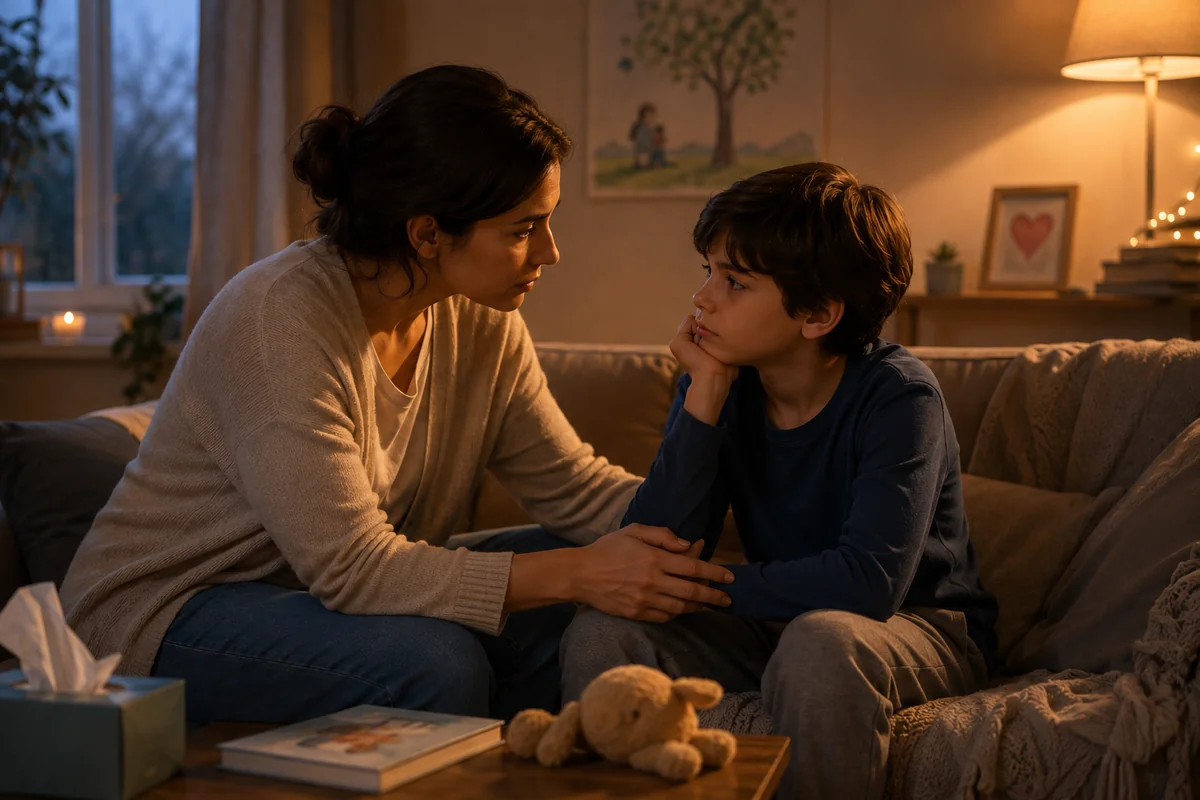
Tell your child the truth in simple, clear words, using “died” rather than softer phrases, and match how much you say to their age. Reassure them they are safe and it was no one’s fault, let them see your own sadness, invite their questions, and keep their routines steady while they take it in.
In practice, one of the first things I notice with families is that children do not receive news of a death the way adults do. A four-year-old may ask if the person will be back for their birthday. A ten-year-old may want to know exactly what happened to the body. A teenager may go quiet and then, weeks later, ask a question about what happens after we die. None of these responses are wrong. They are simply different minds meeting the same hard fact from different starting points.
That is the heart of this whole conversation. There is no perfect script, and you do not need one. What children need is honesty, reassurance, and a parent who is willing to stay in the conversation even when they do not have all the answers.
Start From What Your Child Can Actually Hold
Before the words come the questions behind them. What does a child this age understand about death? What are they secretly afraid of? What will they take literally?
Interestingly, research on how children come to understand death finds they begin grasping its key aspects as early as four or five, and their understanding grows more complete and more biological with age. So a preschooler and a ten-year-old are not just hearing the same news at different volumes. They are working with genuinely different mental tools.
This matters because the same sentence can comfort one child and confuse another. The guidance below is built stage by stage so you can meet your child where they are.
The Age-By-Age Guide to Talking About Death
Use these as gentle guides, not strict rules. Children move between stages, and grief can pull a child temporarily backward to an earlier way of coping.
-
Toddlers (roughly 1 to 3). At this age there is no real concept of permanence. A toddler cannot understand that death is forever, and may keep asking for the person who has gone. What they feel most is the change in the emotional weather around them and any disruption to their routine. Use very simple, concrete words. Keep mealtimes, naps, and bedtime as steady as you can. Offer plenty of physical closeness and reassurance. You are not explaining death so much as keeping their world safe.
-
Preschoolers (roughly 3 to 5). This is the age of magical thinking. Preschoolers often believe death is reversible, like a character who gets back up, and they may quietly assume they caused it with a bad thought or an angry wish. They also take words very literally, which is why euphemisms like “sleeping” or “went away” can backfire and create fear of sleep or of anyone leaving. Give them clear, simple truth: the person died, which means their body stopped working and they will not come back. Then reassure them, more than once, that it was not their fault and that they are loved and safe.
-
School-age (roughly 6 to 12). By now children usually grasp that death is permanent, universal, and has a cause. They tend to ask concrete and sometimes startlingly blunt questions about bodies, burial, illness, and what happens next. This bluntness is not disrespect. It is how they build understanding. Give honest, factual answers at the level they ask for, and leave room for big feelings that may include anger, guilt, or fear about their own family. Let them know no question is off limits.
-
Teens (roughly 13 and older). Teenagers understand death fully, and that is exactly why it can hit so hard. They grapple with meaning, mortality, and existential questions, sometimes privately. Include them in what is happening rather than protecting them out of the loop. Offer honesty, be willing to sit with uncertainty, and allow them their own way of grieving, which might look like withdrawal, intense feeling, or throwing themselves into friends and activity. Your steady availability matters more than any speech.
Along the same lines, research breaks the idea of death into parts children learn at different stages, that it is permanent, universal, and has a cause, which is why what you say has to match your child’s age.
When a Grandparent Dies: The First Loss Many Children Face
For most children, the death of a grandparent is their first real encounter with loss. It carries its own tenderness, because you are often grieving your own parent while trying to guide your child through theirs.
Here is a simple way to approach it.
-
Use the real words. Say “Grandma died,” not “we lost her” or “she passed away.” Younger children take “lost” literally and may wonder why no one is looking for her.
-
Keep it simple and true. Explain plainly what happened in a way that fits your child’s age. “Grandpa was very old and very sick, and his body stopped working. That means he died and he will not come back.” You do not need every medical detail.
-
Reassure them about safety. Children often quietly wonder whether this will happen to you, or to them. Tell them that most people live a very long time, that you are healthy and plan to be around, and that they are safe. Say clearly that no one did anything to cause this and it was nobody’s fault.
-
Let them see your sadness. When you say, “I feel very sad because I loved Grandma and I miss her,” you teach your child that grief is allowed and that tears are not something to hide. This is one of the most freeing gifts you can give.
-
Keep the grandparent’s memory alive. Look at photos together, tell stories, cook a dish they loved, keep a small keepsake. Memory-keeping helps children understand that a person can be gone and still deeply loved.
-
Handle the funeral gently. More on this below, because it is one of the most common questions parents ask.
You do not have to be composed and certain to help your child through loss. A parent who says “I am sad too, and we will get through this together” gives a child something far more useful than a flawless explanation: permission to feel, and proof that they are not alone in it.
The Words That Help, and the Words That Confuse
A few general principles hold true across every age.
Be honest. Children sense when something is being hidden, and their imagination often fills the gap with something scarier than the truth.
Use clear words. “Died” and “death” are the words that land cleanly, especially for younger children.
Invite questions and answer the one they actually asked, not the one you fear. If a child asks where Grandma is now, you can ask gently, “What do you think?” to hear what they already believe before you respond.
Let them see you grieve, in a way that does not frighten them. Showing sadness is different from being so overwhelmed that your child feels they must take care of you.
Keep routines. Predictable meals, school, and bedtime are reassuring anchors when the emotional ground has shifted.
And a short list of phrases to avoid with young children, because they invite confusion or fear:
- “She’s sleeping” or “resting,” which can make bedtime terrifying.
- “We lost him,” which sounds like something to be found.
- “He went away” or “on a long journey,” which suggests he might return.
- “God took her because she was so good,” which can make a child fear being good.
If faith is part of your family’s life, you can absolutely share your beliefs. Just pair them with the plain fact that the person’s body has died and will not come back, so the concrete and the spiritual do not blur into confusion.
Grief in Children Rarely Looks Like Grief in Adults
Many parents worry when a child seems fine one moment and cheerful the next. This is normal. Children grieve in waves. They dip into sadness, then step out to play, then return to it later. Play itself is often how they process loss, so do not be alarmed if a young child acts out a funeral with toys or asks the same question again and again.
You may also see regression, such as bedwetting, clinginess, or thumb-sucking in a child who had moved past it. Older children may become irritable, struggle to concentrate at school, or complain of stomachaches and headaches. All of this is part of the normal range.
Notably, research looking at how children picture death shows younger children focus on the concrete and physical while older children begin to hold more abstract and emotional understandings. That is why the same loss can surface as a body question in one child and a why-does-this-happen question in another.
Through all of this, taking care of yourself is not a luxury. Your own steadiness is what your child leans on, and part of that is honestly attending to coping with your own grief and loss so you are not running on empty while you support them.
When Grief May Need Extra Support
Most children move through grief with time, patience, and a present parent. Sometimes, though, they need more help. Consider reaching out to a professional if, over several weeks or more, your child shows persistent trouble sleeping or eating, ongoing separation fear, sustained withdrawal from friends and activities they used to enjoy, aggression that is new or intense, a lasting drop at school, or any talk of wanting to die or join the person who died.
It helps to know the signs your child is struggling emotionally so you can tell the difference between the normal waves of grief and something that calls for support. Trust your instinct too. If your gut says your child is stuck, that is worth acting on.
Supporting a grieving child is also part of the wider, everyday work of nurturing your child’s emotional wellness, and asking for help is a sign of good parenting, not a failure of it.
What I Hope You Carry From This
If you take one thing from all of this, let it be that you do not need the right words to do right by your child. You need honest words, gentle reassurance, and a willingness to keep the conversation open long after the first hard talk is over.
Children are more resilient than we fear and more perceptive than we assume. When you tell them the truth, sit with their feelings, and let them see that grief and love can live side by side, you are giving them something they will carry for life: the sense that hard things can be faced, together, and survived.
FAQ
Frequently Asked Questions
How do I explain death to a child by age?
Match your words to what your child can understand. Toddlers need routine and reassurance rather than explanation, preschoolers need clear simple truth and reassurance it was not their fault, school-age children can handle honest factual answers to blunt questions, and teens need to be included and allowed their own way of grieving. Move gently and follow their questions.
What should I say when a grandparent dies?
Use the real word "died," and explain simply what happened at your child's level, for example that the person was very old or very sick and their body stopped working. Reassure your child that they and their parents are safe and that it was no one's fault. Let them see your own sadness, and keep the grandparent's memory alive through photos and stories.
Should I use the word died or say passed away or sleeping?
Use "died" and "death," especially with younger children. Phrases like "passed away," "lost," "sleeping," or "went away" are taken literally by young children and can create confusion or fear, such as being afraid of sleep or waiting for the person to return. Clear words are kinder because they prevent misunderstanding.
Should my child attend the funeral?
There is no single right answer, but many children benefit from being included in a way that suits their age. Explain beforehand what will happen and what they might see and hear, let them ask questions, and give them the choice where possible. Arrange for a trusted adult to take them out if it becomes too much, and never force a child who firmly does not want to go.
How do I know if my child needs extra help with grief?
Grief that comes and goes in waves, including play and regression, is normal. Consider professional support if, over several weeks or more, you see persistent trouble sleeping or eating, ongoing withdrawal, new or intense aggression, a lasting drop at school, or any talk of wanting to die. Trust your instinct if your child seems stuck, and reach out for help early.