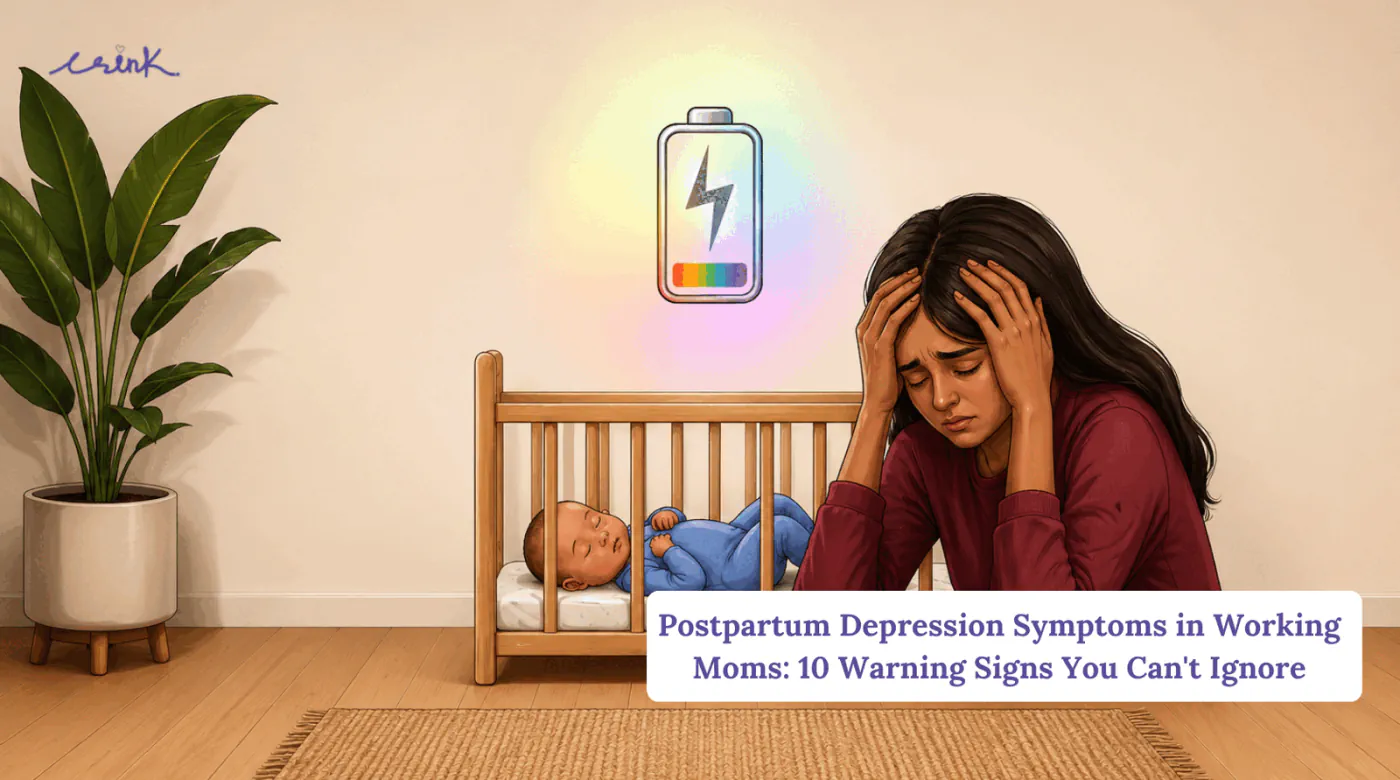
Postpartum Depression Symptoms in Working Moms: 10 Warning Signs You Can't Ignore
- Blessy Varghese

- 5 hours ago
- 11 min read
Postpartum depression (PPD) is one of the most common complications of childbirth, affecting roughly one in five mothers. Yet it remains significantly underrecognized, in part because many people still picture it as a mother who cannot get out of bed or who is visibly weeping. The clinical reality is far more varied. PPD can show up emotionally as numbness, rage, or guilt. It can show up physically as bone-deep exhaustion or an inability to eat. It can show up behaviorally as withdrawing from people you love. And it can show up professionally as a quiet, creeping inability to think, concentrate, or care about work that once gave you purpose.
Postpartum depression does not always announce itself with tears. For many mothers, especially those who have returned to work, who have other children to care for, who have built entire identities around competence and composure, it hides behind a fully functioning exterior. She attends the meeting. She answers the emails. She packs the lunch. And inside, something is quietly coming apart.
If you have found yourself searching for answers - "Why am I so angry all the time?" or "Why do I feel nothing when I look at my baby?" or "Why am I overwhelmed by things I used to handle easily?", you are not alone, and you are not failing. You may be experiencing something that has a name, a clinical understanding, and, importantly, a path toward feeling better.
This article is not here to alarm you. It is here to help you recognize what you may be experiencing with accuracy, and without shame. Whether you are seeking information, support, or exploring options for Postpartum Depression Treatment in Kerala, understanding the signs of PPD is an important first step toward recovery and well-being.
Emotional Symptoms of Postpartum Depression
The emotional landscape of postpartum depression is far wider than most people realize. Sadness is only one color in it, and it is not always the dominant one.
Some of the most common emotional symptoms include persistent low mood that does not lift after rest or reassurance; a hollow, grey sense of numbness where emotions once lived; irritability so raw that small sounds or minor inconveniences feel unbearable; and episodes of rage that arrive without warning and leave behind a wave of guilt and shame.
Guilt is itself one of the most painful features of PPD. Many mothers feel guilty not for anything they have done wrong, but for what they are not feeling. They expect to feel the full-body love that culture promises. Instead, they feel tired, disconnected, or quietly resentful and then deeply ashamed of those feelings.
The kind of emotional disconnection, where a mother feels little or no attachment to her baby, is a recognized symptom of PPD, not evidence of being a bad mother. The brain and nervous system under chronic stress, sleep deprivation, and hormonal disruption do not always produce the emotional responses we expect of ourselves.
Intrusive thoughts are another symptom that carries enormous, unnecessary shame. Many mothers with PPD experience unwanted, frightening mental images; thoughts of harm, of accidents, of catastrophe, that feel repulsive to them. These thoughts are not wishes. They are a feature of an anxious, dysregulated nervous system trying to protect them. They do not make someone dangerous. But they can make a mother feel monstrous, and silence becomes her only coping strategy.
Other emotional symptoms worth naming:
Crying suddenly and not knowing why or, equally, being unable to cry at all
Hopelessness- a flat sense that things will not improve
A persistent feeling of being a bad mother, of failing your child
Feeling emotionally alone even when surrounded by people who care about you
A grief for the version of yourself that existed before
Feeling emotionally alone in a room full of people is not ingratitude. It is a symptom. One worth taking seriously.
Physical & Behavioral Warning Signs
Postpartum depression is not only an emotional experience. It is felt in the body, and it shows up in behavior in ways that can be easy to attribute to other causes- new parenthood, stress, poor sleep. The challenge is knowing when a constellation of symptoms crosses from "adjustment" into something that needs support.
Exhaustion is the most commonly dismissed symptom. Every new mother is tired, that is expected and understandable. But the exhaustion of postpartum depression has a different quality. It does not improve meaningfully with sleep. It does not lift when the baby settles. It is a deep, pervasive fatigue that makes even the smallest tasks feel like effort against gravity.
Loss of motivation is closely related. Things that used to feel meaningful, hobbies, friendships, even moments with your baby feel flat and unreachable. Getting dressed can feel like a significant undertaking. This is not laziness. It is a classic sign that the brain's reward and motivation systems are under serious strain.
Physical symptoms of PPD also frequently include changes in appetite- eating very little or turning to food compulsively as a way of managing emotional numbness. Headaches, digestive disruption, and physical tension are common. Concentration and memory are often significantly affected, which can be frightening for women who have always been high functioning.
Behaviorally, postpartum depression often looks like withdrawal. Cancelling plans. Not responding to messages. Avoiding social situations that would require sustained emotional performance. The effort of appearing fine, for hours at a stretch, is exhausting and so the path of least resistance becomes isolation.
One behavioral pattern that is rarely discussed openly is emotional overstimulation, particularly around a baby's crying. For many mothers with PPD, a baby's cry does not trigger the expected nurturing response. Instead, it triggers something that feels much closer to panic, or rage. The sound becomes physically overwhelming. This reaction creates enormous shame, but it is a well-recognized feature of postpartum depression's impact on the nervous system's stress response.
A few other signs worth paying attention to:
Difficulty completing routine caregiving tasks that once felt manageable
Reacting more intensely than the situation warrants- snapping, shouting, going silent
Struggling to find any pleasure or relief in moments that should feel meaningful
Emotional shutdown — going through the motions without really being present
A persistent sense of dread, or an inability to feel safe
None of these symptoms exist in isolation, and none of them define you as a mother. They are information. They are the mind and body asking for something that is not yet available to them.
Workplace Impact & Professional Triggers
For working mothers, postpartum depression carries a particular weight that is rarely acknowledged in clinical discussions: the professional dimension. Because work is often the space where a woman has historically felt most competent, most like herself, the experience of struggling there can feel like a final and catastrophic loss.
Concentration is one of the earliest casualties. Sitting through a meeting that would once have been manageable becomes quietly agonizing, thoughts scatter; words are missed, the thread of a conversation slips. Emails pile up not because of laziness but because the act of reading them, processing them, and formulating a response requires a cognitive and emotional bandwidth that simply is not available. This is sometimes described clinically as the "brain fog" of PPD, and it is real and measurable.
Calling in sick frequently, struggling to meet deadlines, arriving and leaving without really having been present are the behavioral footprint of an overwhelmed nervous system trying to protect itself. And yet, in professional environments where performance is visible and colleagues are unaware of what is happening, the internal experience of a mother with PPD is one of profound, corrosive shame.
There is also the layered guilt that working mothers navigate in ways that can be genuinely destabilizing. Guilt at work, for not being fully present, for not performing as before, for needing support she has not asked for. And simultaneously, guilt at home for being away, for not doing more, for finding relief in the structure of work and then feeling terrible about that relief. This two-sided guilt is exhausting to live inside.
The identity conflict is equally significant. Many women have spent years building a professional self- one that is capable, dependable, ambitious. Postpartum depression disrupts that identity without warning. A mother who once led teams, managed complexity, and thrived under pressure may find herself unable to draft a simple email without her hands trembling slightly. The distance between who she was and what she can access right now can feel unbridgeable.
Recovery in a professional context is possible. It does not require abandoning ambition or pretending to be fine. It requires accurate support, an honest conversation with at least one person, and time.
10 Warning Signs of Postpartum Depression in Working Moms

These signs can appear individually or together. They may be present in mild or severe forms. What matters is the pattern- the persistence, the interference with daily life, and the distance between how you feel and how you want to feel.
Persistent emotional numbness- feeling flat, distant, or detached from your own life and from your baby
Irritability or rage disproportionate to circumstances- snapping at a partner, feeling overwhelmed by a baby's crying, reacting intensely to minor stressors
Overwhelming guilt and self-criticism, particularly guilt for not feeling the love or joy you expected to feel
Intrusive, frightening, or unwanted thoughts that feel completely at odds with who you are
Profound exhaustion that does not improve with rest- physically heavy, cognitively slow, emotionally depleted
Loss of interest or pleasure in things that used to matter- work, hobbies, friendships, intimacy
Withdrawing from relationships- cancelling plans, avoiding contact, struggling to be present even with people you love
Difficulty concentrating at work- brain fog, memory lapses, difficulty following conversations or completing tasks
Emotional disconnection from your baby, going through caregiving routines without feeling emotionally present or attached
A pervasive sense that things will not get better- hopelessness, or a quiet belief that you are fundamentally broken
If several of these resonate, especially if they have persisted for more than two weeks and are affecting your daily life, please consider reaching out to a mental health professional. You do not have to be certain. You do not have to have every symptom. Your instinct that something is wrong is enough.
5 Steps Working Mom post s Can Take Right Now
Recovery from Post Partum Depression is not linear, and it is not simple. There is no checklist that, once completed, makes you well.

1. Reach Out to a Mental Health Professional
This is the most important step, and often the hardest. Postpartum depression responds well to treatment- both therapy and, when clinically appropriate, medication. A psychologist or therapist who specializes in perinatal mental health can help you understand what you are experiencing, develop emotional regulation skills, and begin to process the identity shifts that come with new motherhood. You do not have to be in crisis to deserve support.
2. Say It Out Loud to One Person
Isolation is one of the most powerful forces that maintains postpartum depression. Finding one person- a partner, a friend, a sibling, a doctor and telling them honestly that you are struggling can feel monumental. It often is. It also begins to break the silence that shame requires to survive.
3. Reduce Invisible Labor Where Possible
Working mothers with PPD are often carrying invisible loads that are not acknowledged- emotional labor, mental load, second-shift caregiving, professional performance. While it is not always possible to put these down entirely, it is worth asking: where is there room to reduce? What tasks can be delegated, deprioritized, or asked for help with? This is not about lowering your standards. It is about directing your limited energy toward survival and recovery first.
4. Involve Your Support System, Even Imperfectly
Partners, family members, and close friends often want to help and do not know how. Being specific: "Can you take the baby for two hours on Saturday morning?" rather than "I need more support" makes help more likely to materialize. You should not have to coordinate your own support while also recovering. But where it is possible, specific requests tend to produce better outcomes than general ones.
5. Extend the Same Compassion to Yourself That You Would to a Friend
This sounds simple. It is not. Most mothers with PPD hold themselves to a standard of performance and feeling that they would never apply to someone they loved. When a moment of anger passes, when a caregiving task feels resentful, when work is difficult- the internal response is often brutal self-criticism. Practicing self-compassion does not mean accepting suffering. It means treating your own struggle with the same gentleness and accuracy you would bring to someone else's.
Recovery is not a return to who you were before. It is, with time and the right support, the development of something more honest, a version of yourself that knows more, carries more, and is more capable of asking for what she needs.
You Are Not a Bad Mother. You Are a Mother Who Is Struggling.
Postpartum depression looks different in every woman who experiences it. It can be visible or invisible. Loud or completely silent. It can coexist with genuine love for your child, with professional achievement, with a smile that fools everyone. It does not follow a script.
What it does consistently do is create distance between you and your baby, between you and the people around you, between you and the version of yourself you expected to be. That distance is not permanent, and it is not your fault.
You are allowed to be struggling and to be a good mother simultaneously. These are not mutually exclusive. And naming it, seeking help for it, is one of the most courageous things you can do.
At Crink, many mothers seek support for the numbness, the rage, the guilt, the quiet sense that something has shifted, and they cannot find their way back. Recovery is possible. It is not always fast, and it is not always straightforward, but with the right psychological support and a space to be honest, it happens. If you are ready to take the first step, we are here.
Frequently Asked Questions
What is the difference between baby blues and postpartum depression?
Baby blues are very common, affecting up to 80% of mothers and typically appear within the first few days after birth. They involve tearfulness, mood swings, and emotional sensitivity that generally resolve within one to two weeks without treatment. Postpartum depression is distinct in its duration, intensity, and interference with daily functioning. It persists beyond two weeks, often worsening over time without support, and affects a mother's ability to care for herself and her baby, maintain relationships, and function at work. If symptoms are not improving after the first two weeks, or if they are severe at any point, it is important to speak with a healthcare provider.
Can postpartum depression cause anger rather than sadness?
Yes, and this is one of the most underrecognized aspects of PPD. Many mothers do not experience the sadness they associate with depression. Instead, the predominant experience is irritability, rage, or emotional volatility. This can be confusing and shaming, particularly when the anger is directed at a partner, an older child, or even the baby. The neurobiological disruption underlying postpartum depression affects the brain's threat-response and emotional regulation systems, which means heightened reactivity and rage are legitimate symptoms and not moral failures.
When should I seek professional help?
If you are experiencing symptoms that have persisted for more than two weeks, are interfering with your ability to function at work or at home, or are causing you significant distress, seek support now. You do not need to be at a crisis point to deserve help. Early intervention is associated with better outcomes. If at any point you are experiencing thoughts of harming yourself or your baby, please reach out to a mental health professional or emergency service immediately.
Are working mothers more vulnerable to postpartum depression?
Research suggests that working mothers face a specific set of risk factors that can increase vulnerability to PPD: the pressure to return to a high-functioning professional role before emotional recovery is complete, the guilt of dual obligations, the loss of recovery time, and the absence of acknowledgement that something significant has changed. This does not mean every working mother will develop PPD. But the intersection of identity disruption, performance pressure, and inadequate support creates conditions worth taking seriously. Working mothers also tend to underreport symptoms, which delays support.
Is recovery from postpartum depression possible?
Yes, fully and genuinely. With appropriate treatment, most mothers recover from postpartum depression. Therapy, particularly approaches focused on emotional regulation, identity integration, and self-compassion, can be profoundly effective. Where clinically indicated, medication can also be considered safely, including during breastfeeding. Recovery does not mean the experience disappears, or that things return exactly to how they were. But it does mean regaining access to yourself, your capacity for connection, for pleasure, for presence. That is possible, and it is worth pursuing.
.png)


Comments