
Self
Can AI Help With Stress, Anxiety, and Emotional Overload?
Can AI genuinely help with stress and anxiety? A psychologist-reviewed look at what the research shows AI can do, where it falls short, and how to use it safely.
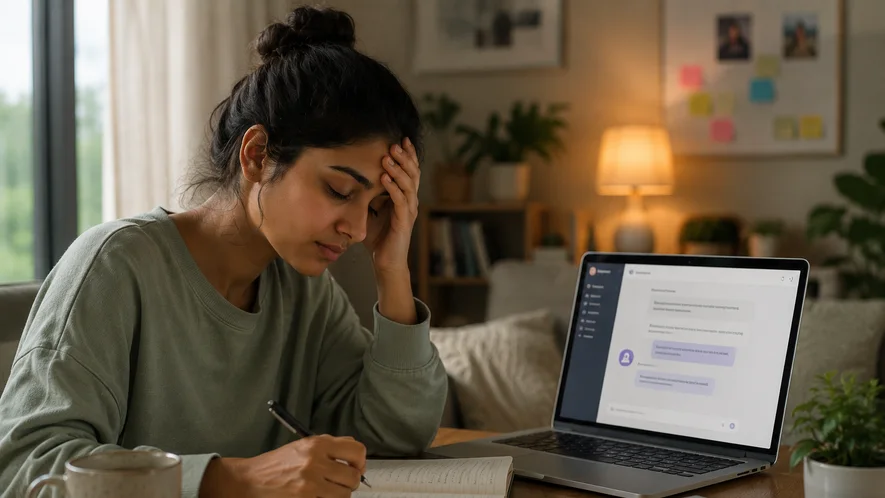
Question: Can AI actually help with stress, anxiety, and emotional overload?
Yes, within limits. Good evidence shows AI tools like therapy chatbots can reduce symptoms of stress, anxiety, and low mood, especially for mild to moderate concerns and as support between sessions. But AI is not a replacement for a human professional when distress is affecting your daily life, and current AI carries real risks like inaccurate or inconsistent responses.
You feel it at 11pm when your mind will not switch off, or mid-meeting when your chest tightens for no obvious reason. AI is right there, always awake, never judging. So the question is fair: can it actually help, or is it just a smarter way to avoid dealing with things?
For a lot of people, the appeal is privacy and immediacy. When your stress shows up as racing thoughts after a review cycle or doom-scrolling before bed, instant access feels useful. The important distinction is this: AI can be helpful because it is immediate, but that does not make it complete.
What the research actually shows AI can do
The evidence is more encouraging than sceptics expect. In a randomized controlled trial published in JMIR Mental Health, the AI chatbot Tess produced significant reductions in depression and anxiety symptoms compared with an information-only control. According to a three-arm randomized trial in the Journal of Medical Internet Research, a CBT-based chatbot lowered depression scores more than an e-book or a general chatbot, with effects still visible a month later. So for everyday stress and sub-clinical anxiety, a well-designed AI tool can genuinely take the edge off.
A newer 2024 meta-analysis of 18 randomized trials reached a similar conclusion: AI-based chatbots produced meaningful short-course improvements in depression and anxiety, with the strongest benefits around eight weeks. The same review also found those gains were less clear by three months, which is useful context. AI seems to work best as a bridge and a booster, not as a full long-term treatment plan on its own.
That makes sense when you look at what these tools are actually good at. They can help you slow a fast thought, label a feeling, turn vague dread into a concrete sentence, walk through a breathing exercise, or capture a pattern before it disappears. If you have ever known you were overwhelmed but could not name why, that kind of structure can lower the temperature quickly.
Where AI falls short (and why this matters)
Here is the part the app stores do not advertise. According to a 2024 systematic review in JMIR Mental Health, large language models are good at detecting concerns through text, but carry real risks for clinical use: hallucinations, inconsistencies in what they generate, and the absence of a comprehensive ethical framework. In plain terms: AI can sound confident and still be wrong, and it does not truly hold responsibility for your care.
A 2025 review of large language models in mental health care sharpens that concern. It found most studies still focus on technical feasibility, while safety, hallucination risk, and long-term therapeutic outcomes remain under-evaluated. That matters because emotional support is not the same as sounding emotionally fluent.
AI also has no durable clinical judgment. It does not notice the way a therapist notices. It may not catch that your “work stress” is actually panic, that your “sleep issue” is tied to grief, or that your cheerful tone is covering how close to burnout you are. It responds to the text in front of it, not to the pattern of your life across weeks and months.
If you are typing highly personal material into any mental health tool, privacy deserves a real look too. A JAMA Network Open assessment of health apps found third-party data sharing was common and often poorly disclosed, so it is worth checking what the product stores, shares, and uses for training before you get comfortable there.
Wondering if it is everyday stress or something more? Take the free 2-minute Stress Assessment.
Take the free Stress Assessment ->The honest line: support, not substitute
Think of AI as the layer that helps you in the moment and between sessions, naming what you feel, guiding a breathing exercise, helping you reflect before bed. The human professional is who you need when the overload is steady, when it touches sleep, work, or relationships, or when you feel unsafe.
Used well, AI is especially helpful in four situations:
- De-escalation in the moment. When your nervous system is spiking after a fight, a brutal inbox, or a hard performance conversation, a guided prompt can help you get from flooded to functional.
- Reflection between sessions. If you work with a therapist, AI can help you capture the exact wording of the thought that hit at 11:40pm so you do not forget it by morning.
- Practice before real life. It can help you rehearse a boundary message, list what you want to say in session, or identify what part of the day keeps tipping you over.
- A bridge, not a bunker. If the same issue keeps coming back, the best use of AI is often to point you toward human care, not keep you circling inside the same conversation.
Use AI like a torch, not a surgeon. It is wonderful for seeing your way through a dark moment, but not the one who should operate when something deeper needs care.
This is also why how you wind down matters. Our piece on why sleep is the foundation of mental health pairs well with using AI wisely.
If you are trying to tell ordinary stress from a panic response, attack vs anxiety is a useful read.
If you want the bigger picture on blended support, AI-native mental wellbeing: human plus AI explains that model more fully.
What Crink offers
Crink pairs Cri, an AI companion for everyday support, with licensed consultant psychologists for the work that needs a human. You decide the pace; the handoff is built in.
The point is to let technology handle immediacy while a clinician handles judgment, continuity, and responsibility.
FAQ
Frequently asked questions
Can an AI chatbot reduce my anxiety?
Research shows well-designed therapy chatbots can reduce anxiety and depressive symptoms, particularly for mild to moderate concerns. They work best as support alongside, not instead of, professional care.
Is it safe to rely only on AI for my mental health?
Not when distress is affecting your daily functioning, sleep, work, or relationships, or if you feel unsafe. Current AI can be inconsistent or inaccurate, so a human professional should lead actual care.
When should I stop using AI and see a real therapist?
When the overload is persistent rather than occasional, when it disrupts your day-to-day life, or when you have thoughts of harming yourself. Those are signals to talk to a professional.
What is AI genuinely good at here?
In-the-moment relief, reflection, mood tracking, psychoeducation, and helping you articulate feelings before a session.
Updated on June 20, 2026