
Self
AI-Native Mental Wellbeing: Why Human + AI Therapy Changes Everything
Discover how AI-native therapy bridges the gap between sessions. Learn why Human + AI support beats episodic counselling for busy professionals.
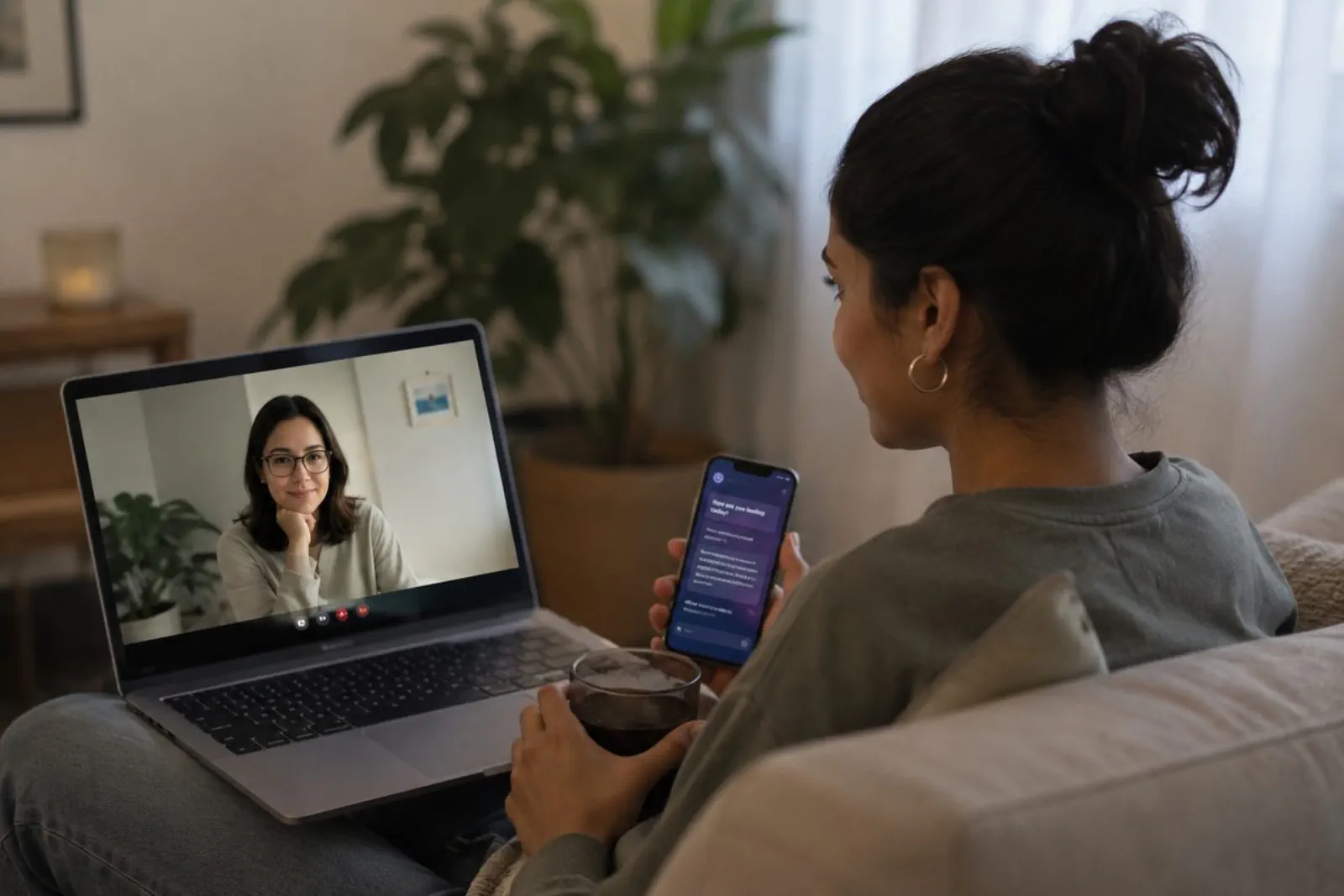
You’re a director at a mid-market tech firm. On paper, you’ve cracked it: title, salary, autonomy. But between that Monday morning panic spiral and your Thursday 4 PM therapy session, you’re white-knuckling it alone. Your therapist is brilliant, but they see you once a week. The other 10,080 minutes? You’re navigating doubt, burnout, and overwhelm unsupported. That gap between sessions isn’t a scheduling inconvenience. It’s where most wellbeing actually fails.
AI-native mental wellbeing flips that script. It’s not therapy replaced by chatbots. It’s the gold-standard human therapeutic relationship plus continuous AI-powered support that lives between sessions, learns your context, and meets you exactly where you struggle most. Below, we’ll explore what this means, why it works, and how the three-way context flywheel compounds support over time.
The Gap Nobody Talks About: Why Episodic Therapy Isn’t Enough
Traditional therapy is episodic. You book a slot (often weeks out), show up, spend 50 minutes unpacking, then walk back into your life for seven days with one set of tools and a notebook. Your therapist goes home. Tomorrow, when you spiral, they’re not there. Next week, they’ve forgotten half the context. You have to re-anchor.
The data tells a clear story. Roughly one in five therapy clients drop out before finishing their planned course of treatment. A large meta-analysis of 669 studies and more than 83,000 clients put the average dropout rate at about 19.7% (Swift & Greenberg, 2012). The research points to a few common drivers: a weak therapeutic alliance, mismatched expectations about how therapy works, and practical friction like cost and scheduling. We would add one more from what we see every day at Crink (and this part is our own view, not a finding from that study): the long, unsupported gap between sessions, when the work is hardest to hold onto alone. For high-performing professionals juggling competing demands, that gap is a chasm. And you deserve support when the moment is hardest, not only when your calendar finally clears a Tuesday afternoon.
Here’s what happens in that gap:
Moment of doubt. You make a decision at work that triggers old patterns (people-pleasing, perfectionism, conflict avoidance). Your therapist isn’t there. You spiral or muscle through alone.
Forgotten learning. Your therapist said something brilliant last week. You remember it was about boundaries, but not the exact frame. By the time you reconstruct it, the moment has passed.
Isolation compounds shame. You white-knuckle through another minor crisis, then arrive at your next session feeling like you “failed” because you didn’t apply the tools well enough.
Compounding doubt. Each unsupported moment erodes your confidence in the work itself. Maybe therapy isn’t sticking. Maybe you’re the problem.
None of that is true. The process is the problem. The model is broken for modern life.
What Is AI-Native Mental Wellbeing?
AI-native mental wellbeing is a reimagining of therapy from the ground up. Instead of episodic sessions floating in isolation, it’s a continuous Human + AI system designed to collapse that between-session gap.
Three core moves define it:
1. The AI Companion Lives Between Sessions
You have an AI co-pilot, Cri, an always-on AI support layer that you can talk to whenever doubt hits: 2 AM, during lunch, after a difficult meeting. Not a chatbot that gives generic advice. An AI trained on therapeutic principles, continuously learning your specific patterns, contexts, and what helps you.
When you’re spiralling about a presentation, Cri doesn’t say “try breathing exercises.” It knows you’ve worked with your consultant on perfectionism and catastrophizing. It gently mirrors back the pattern you’re caught in, reminds you of the frame you’ve already built, and nudges you toward the agency you actually have.
This isn’t replacing your human therapist. It’s making sure you have expert support available at the moment of need, which is when learning sticks.
2. Your Human Consultant Walks In Already Briefed
The second lever is context compression. Cri logs your between-session conversations: what triggered you, how you handled it, where you got stuck, what helped. Your consultant doesn’t read those raw conversations. They receive a concise summary of your week, so when you next meet they don’t start from scratch. They walk in already knowing its live texture.
Your consultant can then go deeper. Instead of the first 20 minutes re-anchoring context, you spend the full session on what actually matters: why that pattern keeps looping, what belief is underneath, what change needs to happen.
The shift is simple but profound: change rarely happens during the session itself. It happens in the small, everyday moments between them. When people feel supported in those moments, the growth actually holds.
3. The Three-Way Context Flywheel Compounds
Here’s where it gets exponential. Over time, three things start to happen:
Cri gets smarter about you. Each conversation, each moment you’re stuck, each time a frame helped, Cri’s model of your patterns sharpens. The support gets more personalized, not less.
Your consultant’s insights deepen. Your consultant sees not just what you tell them, but how you actually move through the week. That changes what they focus on.
Your own self-awareness accelerates. You start to notice patterns before they derail you. Cri becomes like a mirror you check in with, and over weeks and months, you internalize that mirror. You become your own consultant.
This is not self-help. It’s scaffolded mastery. The support slowly withdraws as you integrate the learning, exactly as good pedagogy works.
Why This Matters for Busy Professionals
If you’re reading this, you probably fit a profile: you carry disproportionate load across work and life. You’re “high-functioning” which means people assume you’re fine. You’re not fine between sessions.
The stakes are real. Burnout is now widespread among working professionals. Gallup’s State of the Global Workplace: 2024 report found that about 48% of employees feel burned out at work (Gallup, 2024). One honest caveat: the specific link between burnout and the between-session unsupported gap is our own operating thesis at Crink, not a conclusion drawn by this survey. Episodic support leaves you managing crisis alone, which means:
- Decisions made under unsupported stress are often poor. You people-please, overcommit, or shut down because you don’t have real-time support to think through alternatives.
- Patterns compound. That Monday panic? If you white-knuckle through it solo, you arrive Friday depleted. Each week compounds.
- You become skilled at hiding, not healing. You get good at pushing through, which feels like strength but is actually disconnection.
AI-native mental wellbeing attacks this directly. It collapses the assumption that you should be resilient enough to manage alone. Instead, it says: your support should scale to your actual life, not fit into your calendar’s spare slots.
The Three-Layer Model: How Human + AI Actually Works
To make this concrete, here’s how the layers interact:
Layer 1: Cri (Continuous, Available Now)
You have a dedicated space where you can:
- Journal in real-time about what triggered you and what you’re thinking
- Ask Cri for a specific reframe when you’re stuck in a loop
- Get nudged toward agency when you’re catastrophizing
- Explore a feeling or decision without performance or judgment
- See patterns emerge across weeks and months
Cri operates within clinical frameworks (CBT, psychodynamic awareness, etc.) but in a conversational, peer-to-peer tone. It’s not lecturing. It’s thinking with you.
How Cri is different from a generic chatbot: It’s not pattern-matching to a database of responses. It’s learning your specific triggers, patterns, what kind of reframe actually lands, and what contexts make you most vulnerable. Over time, Cri becomes almost like an internalized voice of your own wisdom.
Layer 2: Human Consultant (Weekly or As-Needed, High-Context)
Your consultant is a trained psychologist or counsellor who meets with you (typically weekly, but flexible). They have access to your Cri conversations (with your control and consent) so they understand:
- The actual texture of your week
- Patterns emerging in real-time
- Where you get most stuck
- What’s working and what isn’t
The consultant uses that context to do deeper work: exploring the why underneath patterns, building new frameworks, and designing change.
The consultant also provides what an AI cannot: the irreplaceable human relationship. The felt sense of being truly seen. The accountability of a real person who knows you and cares about your growth.
Layer 3: The Continuous Loop (Human + AI Feedback)
Here’s the compounding magic:
- You have a session with your consultant. You explore something deep. Your consultant shares a frame or insight.
- You take that into your week. You try applying it. You get stuck.
- You talk to Cri. You’re confused about how to apply the frame. Cri helps you think it through, knows the exact frame your consultant taught you, and meets you with precision.
- Your consultant sees what happened. When you next meet, your consultant sees where the learning is landing and where it’s catching. They adjust.
- The cycle tightens. Each week, the support becomes more targeted because the feedback loop is closed instead of open-ended.
Why It Works: The Evidence Layer
The core mechanisms aren’t new. They’re grounded in wellbeing research:
Between-session work improves outcomes. In cognitive behavioural therapy, clients who engage with structured between-session practice between sessions tend to do better than those who do not. The work you do between sessions is where a lot of the change actually takes hold.
Continuous learning beats episodic learning. Learning that is revisited across spaced intervals tends to stick better than the same material absorbed in a single block. One 50-minute session once a week leaves long gaps in between, where reinforcement in the moments that matter can help the work hold.
Context clarity accelerates insight. When a therapist has accurate data about what’s actually happening in a client’s life (not just what the client can remember or articulate in a session), treatment efficacy improves. That’s just better information design.
Blended human + digital support is promising. A growing body of research on blended therapy (human sessions plus digital, between-session support) suggests it can be as effective as face-to-face care while improving engagement, and in some studies lowering dropout. The evidence is still developing and is strongest for depression and anxiety, so we treat this as promising rather than settled (Erbe et al., 2017, J Med Internet Res).
New patterns take time to settle. Lasting change isn’t a single insight, it’s a behaviour repeated until it becomes automatic. Research on habit formation found it took participants an average of about 66 days for a new behaviour to become automatic, with wide individual variation (Lally et al., 2009, UCL). A weekly session can spark the intention, but the repetitions that actually wire the habit happen in the days between, exactly the window traditional care can’t reach.
Feeling supported in the moment matters. Decades of attachment research and Emotionally Focused Therapy (Sue Johnson) show that responsiveness, the sense that support is there when you reach for it, is what lets people regulate and take risks. A relationship that’s only reachable once a week leaves the hardest moments unheld; continuous support changes the felt experience of not being alone in them.
None of this is magic. It’s engineering better support structures.
How This Reframes the Consultant-Client Relationship
One worry people voice: “Won’t Cri replace my therapist?”
The opposite happens. Because Cri handles continuity, your consultant can actually be more human. They’re not re-anchoring context every session. They’re not fielding routine processing. They’re doing the work that only humans can do:
- Holding complexity and ambiguity without needing to fix it
- Noticing what you’re not saying
- Challenging you when you need to be challenged
- Providing the warmth and attunement that changes the nervous system
- Helping you grieve, celebrate, and transform
Your consultant becomes deeper not because they work harder. It’s because the system is designed smarter.
The Real Cost of Not Changing the Model
Let’s be honest about the alternative. If you stay in episodic therapy:
- You manage most of your struggle alone, which compounds shame and isolation
- You get support that’s perpetually out of sync with your actual life
- Patterns have 6-7 days to loop and strengthen between sessions
- You’re always re-contextualizing, which eats into the depth work
- You white-knuckle through crises, which feels normal because everyone around you does too
- Insight fades between sessions because there’s no reinforcement
That’s not failure on your part. That’s a system designed 80 years ago for a different world. You’re trying to run modern life on episodic infrastructure.
What Happens When You Flip the Model
When you move into Human + AI support, the texture of your life often shifts within weeks:
You notice patterns earlier. Because you have Cri available 24/7, you start catching your own spirals before they fully land. That’s not Cri saving you. That’s you becoming your own expert, with scaffolding.
Your decisions get clearer. When you face a choice (a job offer, a boundary, a commitment), you’re not deciding under unsupported stress. You’ve had a space to think it through with real-time support from Cri.
You actually apply what you learn. In episodic therapy, you often leave the session energized, then forget the frame by Tuesday. In Human + AI, the frame is reinforced continuously because Cri is reminding you when it’s relevant. Learning sticks.
Your consultant’s work goes deeper. Because the foundational support is happening continuously, your sessions can go to the places that actually matter: identity, purpose, the hard internal work.
You feel less alone. This might be the biggest one. You’re not carrying your struggle solo anymore. There’s a system that’s designed to meet you at the moment you’re struggling, not at the moment your schedule allows.
The Build-Out: What AI-Native Looks Like in Practice
A week in AI-native mental wellbeing might look like this (this is a light touch illustration, not a prescription):
Monday: You wake up anxious about a presentation. You journal with Cri about what’s triggering you. Cri notices you’re catastrophizing (something your consultant identified with you weeks ago). It helps you separate the real risk from the imagined risk. You go into the day more anchored.
Wednesday: Presentation happened. It went fine but not perfect. You’re spiralling about “should have” and falling into self-criticism. You talk to Cri. It mirrors back the pattern. You realize it’s the same loop from three weeks ago, and you actually have a tool for it now. You use it.
Thursday: You feel depleted. You’re not sure if it’s work depletion or something else. You journal with Cri. As you’re writing, you realize you haven’t said no to anything in two weeks. There’s the pattern. Cri notes it.
Friday (session day): You meet your consultant. Your consultant has seen a summary of your week with Cri. They know the presentation happened, know the spiral after, know the depletion and the yes-saying. Instead of spending 15 minutes re-anchoring, you go straight to: “I notice I’m struggling to say no even when I’m depleted. What’s underneath that?” Boom. You get 45 minutes of real therapeutic work instead of 35.
That’s not a fantasy. That’s just what happens when the system is designed right.
The Bridge: Where AI-Native Connects to Your Work
If you’re a busy professional, your work and your inner world are inseparable. This pillar (Inner World) connects directly to how you show up at work and in your relationships.
When you’re operating from episodic support, your wellbeing and your professional capability compete. You’re choosing between managing work stress and managing your inner life. Neither gets the full resource you need.
When you’re in Human + AI support, they become mutually reinforcing. You’re more capable at work because Cri supports you continuously. You’re more present in relationships because you’re not carrying unsupported overwhelm. Your inner world and your outer life start to cohere.
That’s what the model is really offering: not therapy that fits into your busy life, but support that scales with you.
FAQ
Frequently asked questions
Is this just a fancy chatbot?
No. Cri is one layer. The human consultant is irreplaceable. What makes this work is the *system*: Cri handling continuity and pattern-noticing, human handling depth, relationship, and transformation. Neither alone works. Together, they compound.
Will my data be private?
Absolutely. Your conversations with Cri are encrypted and under your control. Your consultant doesn't see your full conversation with Cri. They see only a summary of it, and only what you consent to share. We take confidentiality and data security as seriously as any licensed therapy practice.
Do I need to be in crisis to use this?
No. AI-native wellbeing is designed for prevention and growth, not just crisis management. Most people benefit from it because they're managing chronic stress or seeking to deepen their self-awareness, not because they're in acute crisis.
How is this different from journaling apps or self-help?
A journaling app records. Cri thinks *with* you, draws on therapeutic frameworks, learns your patterns, and nudges you toward insight. Self-help is episodic content. Cri is a continuous relationship (with an AI) plus a human consultant who's part of your journey. That's categorically different.
Can an AI really understand what I'm going through?
Cri won't understand with the felt sense a human does. But it can understand *patterns*, can reflect back what you're saying with clarity, and can connect you to frameworks that help. The question isn't "is the AI perfect?" It's "does this system get me better support than waiting a week?" For most people, yes.
How long before I see a difference?
Many people notice shifts in 2-3 weeks: earlier pattern recognition, clearer thinking, fewer unsupported spirals. Deeper change (identity work, belief shifts) takes months. That's true of therapy too. AI-native wellbeing accelerates the timeline because the support is continuous.
Updated on June 18, 2026