Self
AI Therapy vs Traditional Therapy for Anxiety: Which Actually Works?
Compare AI chatbots, traditional therapy, and the Human plus AI model for anxiety. What works, what does not, and how to choose.

You are managing a promotion. Your team depends on you. By 11 PM, your chest tightens. Your mind loops: “What if I let them down? What if I am not enough?” You open an AI chatbot for 15 minutes. It calms you. But next Tuesday the same spiral hits, and you feel alone with it again.
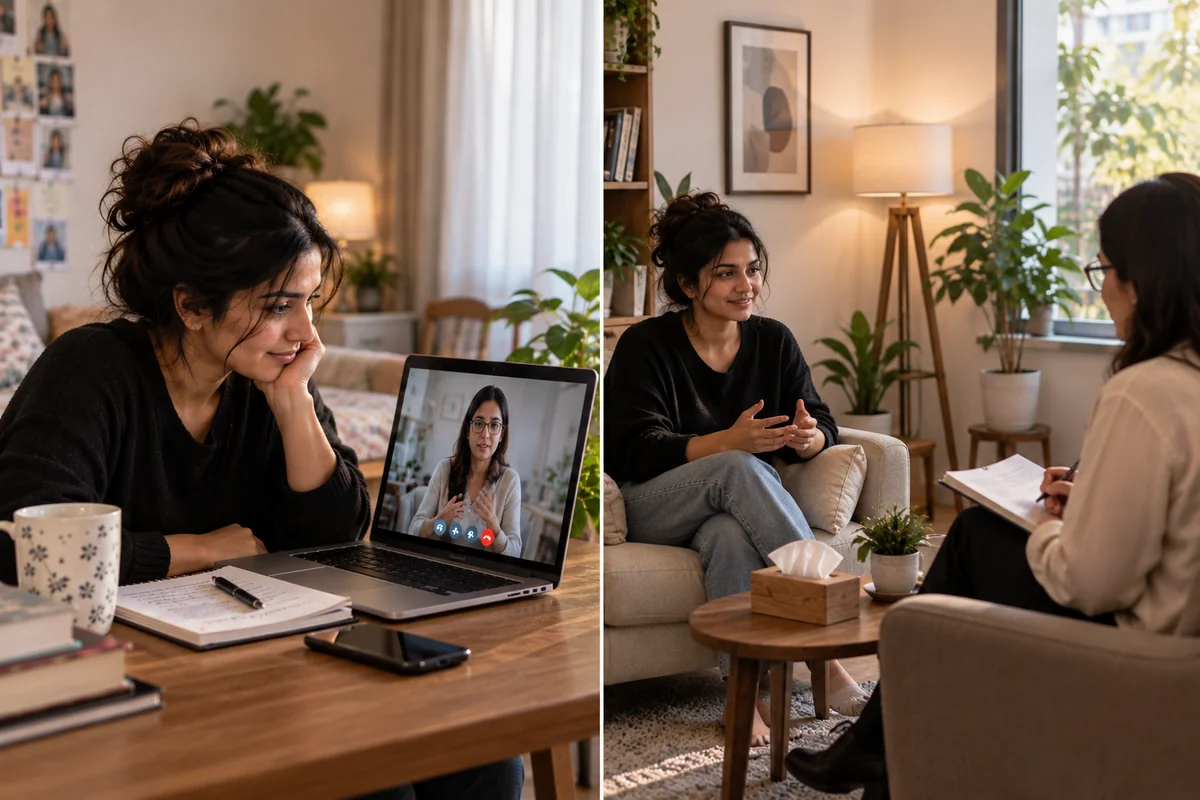
Here is the honest truth: AI alone cannot replace a human consultant for anxiety. But traditional weekly therapy, on its own, leaves most of your week unsupported, and the hours between sessions are exactly when anxiety does its quiet damage. The model that is emerging is Human plus AI: continuous support that compounds over time.
This guide compares all three approaches and shows where each one genuinely fits.
The Three Models Compared
| Dimension | AI-Only Apps | Traditional Therapy | Human plus AI (Crink) |
|---|---|---|---|
| Cost | Low recurring (monthly app subscription) | Higher per-session fee, paid each visit | Mid-range; bundled plan covering human sessions plus between-session support |
| Availability | 24/7 | Weekly or fortnightly booked slots | 24/7 AI plus scheduled human sessions |
| Context continuity | Single-session snapshots; resets per chat | Episodic; the consultant keeps notes and recaps, but has no live window into your week | Cumulative; Cri carries the thread day to day and the consultant is briefed |
| Therapeutic relationship | None (algorithmic) | Gold-standard human bond | Both; human bond plus supportive AI |
| Crisis support | Limited; no accountability | Full accountability; can escalate | Human escalation; AI steady hand between |
| Evidence base | Emerging; some CBT-validated apps | Decades of trial validation | Early but promising; blended human plus digital care |
| Best for | Maintenance; psychoeducation; habit-building | Moderate-to-severe anxiety; deeper identity work | Ongoing support for time-poor professionals |
Why AI-Only Therapy Falls Short for Anxiety
Anxiety is a time-distributed experience. The panic hits at 3 AM. A missed deadline loops during your commute. An AI app responds, sometimes helpfully. But here is what it cannot do.
1. Remember your specific wound the way a person does. You explain a painful history once. A skilled consultant carries that story forward and names the pattern: every promotion triggers the same “I am not enough” fear. That connection is therapeutic gold. It builds trust and shifts belief.
2. Read your non-verbal cues. When you say “I am fine,” a consultant hears the pause and sees your shoulders tense. AI responds to words alone. Anxiety hides in silence and body language, and humans catch it.
3. Hold you accountable in a crisis. An app can suggest a helpline. It cannot make a crisis plan, check whether you acted on it, or refer you to emergency care. Accountability matters most when you are in danger.
4. Be a real relationship. Anxiety thrives in isolation, and the core wound is often “no one really understands.” However warm its tone, an app is not a person who worries about you. For some people, that absence can quietly reinforce the original wound.
Why Weekly Therapy Alone Cannot Cover the Whole Week
Traditional one-on-one therapy is the gold standard for deep work. It simply was not built for the always-on schedule of a high-achieving professional.
You have a session on Thursday. Your consultant offers an insight and you feel a little lighter. Then life happens. By Tuesday the anxiety is back and the insight has faded. Your consultant keeps careful notes and will recap when you next meet, but they have no window into that Tuesday spiral while it is happening.
The arithmetic is stark: one hour a week is 52 hours of support a year. The rest of your waking year, you are navigating on your own. For a time-poor professional, that is where coping mechanisms (overwork, avoidance, a late-night drink) creep in.
This is Crink’s positioning thesis, not a research finding: the lived moments that matter most for change, the small win on Monday, the mid-week doubt, the late-night trigger, happen in a window the weekly format has no way to capture. Published research is more measured about why people leave therapy. According to a large meta-analysis by Swift and Greenberg, about one in five clients drop out, mostly because of a weak therapeutic alliance, mismatched expectations, and practical friction such as cost and scheduling. Crink’s between-session angle is a way to strengthen that alliance and reduce friction, not a claim that gaps alone cause dropout.
Anxiety is not cured in the therapy hour alone. It is loosened in the hundreds of small moments between sessions, when you either practise the new response or fall back on the old one.
What the Evidence Actually Says About AI for Anxiety
Some AI-driven support does help, but only under specific conditions.
Structured, evidence-based programs show promise. Apps that embed Cognitive Behavioural Therapy (CBT) or Acceptance and Commitment Therapy (ACT) modules have shown modest benefit in controlled trials because they follow a blueprint rather than freestyle chatting.
Consistency beats intensity. A simple daily five-minute check-in can do more than sporadic deep conversations, because anxiety is partly a habit and the nervous system re-trains through repetition. Research on habit formation by Lally and colleagues at UCL found new behaviours take around 66 days on average to become automatic, which is far longer than the gap between two therapy sessions. AI is good at the daily nudging that keeps a practice alive across those weeks.
AI is best for the between work, not the core work. Reinforcing a breathing technique you already learned? AI is excellent. Working through the deeper belief underneath the anxiety? You need a human. Reviews of blended human-plus-digital care, such as Erbe and colleagues (2017) in JMIR, describe the combination as promising while noting the evidence is still developing.
The Crink Difference: Human plus AI
Crink’s model is built around the gap directly.
Cri, Crink’s AI companion, lives between sessions. When anxiety hits, Cri helps you name the fear, suggests a technique you have already learned with your consultant, and quietly logs the pattern (for example, recurring worry about client feedback). Cri does not replace your consultant. It holds the thread until your next session.
Your consultant psychologist sees the fuller picture. With your consent, Cri shares a concise summary of how your week went, so your consultant does not start from a blank page. They do the deep work, unpacking the core belief and using the therapeutic relationship, and they adjust the plan based on what shows up in your real-world week.
The result is compounding context. Your support stops being episodic, and the daily practice that anxiety recovery actually depends on finally has somewhere to live. If you want the broader picture of how AI fits alongside human support, see our explainer on whether AI can help with stress, anxiety, and emotional overload.
When AI-Only Is Enough
An AI app is a reasonable choice if you are doing maintenance rather than recovery and just want a low-cost way to stay sharp on tools you already have, if you want psychoeducation to understand how anxiety works, or if you are cost-blocked and it is genuinely this or nothing. But if you are dealing with intrusive thoughts, panic, or avoidance that is shrinking your life, AI-only is like an aspirin for a deeper injury. It can ease the surface. It will not do the healing.
When Weekly Therapy Alone Is the Right Call
Work with a human consultant (with or without AI) if your anxiety is rooted in trauma or attachment wounds and you need a safe, attuned relationship, if you are in a mental health crisis and need real human judgment and escalation, or if you simply prefer depth over breadth. If you go this route, still ask your consultant what you can do between sessions, and use whatever they suggest to bridge the week.
When Human plus AI Shines
This model fits if you are time-poor but anxiety-aware, willing to do the work between sessions, in a high-stakes role where the demands (and therefore the triggers) are continuous, or sceptical of pure AI but in need of more than a monthly session. In each case the point is the same: continuous demands deserve continuous support.
The Honest Bottom Line
AI is not therapy. It is a tool, and a good one in the right context. It will never replace the experience of being heard, challenged, and held by another person. Used alongside human therapy rather than instead of it, AI can cover the part of the week where most of the struggle actually happens. For a professional carrying a heavy load, that is the difference between managing anxiety and slowly mastering it.
The future of anxiety care is not Human versus AI. It is Human plus AI, used honestly and with clear boundaries.
FAQ
Frequently Asked Questions
Can an AI chatbot cure anxiety?
No. Cri can teach you tools such as breathing and thought-reframing, help you track patterns, and provide reminders. But easing anxiety at its root means rewiring beliefs that are often tied to your history and relationships, and that work needs a human. Cri is a practice partner, not a healer.
Is AI therapy cheaper than traditional therapy?
Usually, yes. AI apps are a low monthly subscription, while a human therapist charges a higher fee per session. But price does not equal value. If an AI app does not work, it is wasted money. If therapy works, it is often worth the cost.
What if I cannot afford therapy?
Start with a structured AI app that uses evidence-based CBT or ACT. It is not perfect, but it is evidence-based and low-cost. Many regions also have free or subsidised public options. Check whether your employer offers an Employee Assistance Programme, which often covers a set number of counselling sessions.
Does AI ever need to escalate to a human?
Yes. If you are expressing suicidal thoughts, AI should prompt you to contact emergency services and a human professional immediately. Cri does this. But note: AI cannot force you to act, while a human consultant can actively arrange help. This is a real limitation of AI.
If I use an AI app, do I still need a therapist?
It depends on the severity of your anxiety. If it is mild-to-moderate and you are functional, a structured AI app plus self-help can help. If it is moderate-to-severe and causing avoidance or panic, working with a human consultant alongside Cri is stronger. If you are unsure, speak to a GP.
How do I know if a mental health AI app is legitimate?
Look for a clear privacy policy and data protection, transparency about limits (does it claim to replace therapy?), evidence-based modules such as CBT, ACT, or mindfulness rather than just open-ended chatting, and a crisis escalation pathway. Apps with qualified clinicians behind them are safer.
Updated on June 25, 2026