Crink

Depression

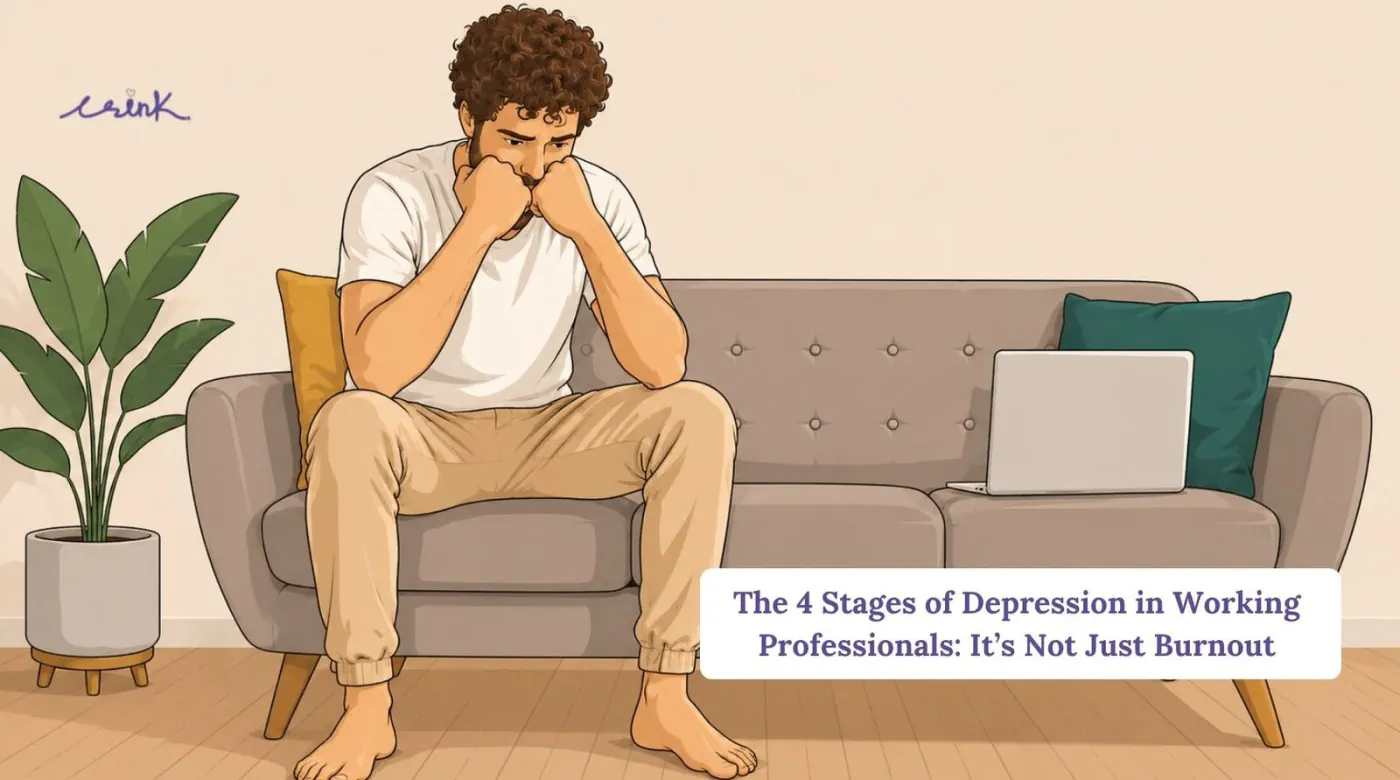
The 4 Stages of Depression in Working Professionals: It’s Not Just Burnout 

The 4 Stages of Depression in Working Professionals

Crink Team 7 min read
The 4 Stages of Depression in Working Professionals: It’s Not Just Burnout 

High-functioning depression is a form of depression where people continue working, managing responsibilities, and showing up for others while experiencing persistent emotional exhaustion, numbness, and disconnection underneath. Unlike visible depression, understanding the 4 stages of depression in professionals helps explain why this form goes undetected for so long, as people mistake each stage for stress or burnout rather than recognizing it as clinical depression. The person is still showing up. Still delivering. Still the person others rely on. That is exactly what makes it invisible and why it goes undetected for so long. Most people picture depression as someone unable to get out of bed. But that represents only one version. The other version high-functioning depression—hides inside a full calendar, delivered projects, and maintained relationships. It doesn't look like depression from the outside. And critically, it often doesn't feel like depression from the inside either. This is why many professionals first explore Online Stress Management counselling in Kerala before recognizing the deeper emotional patterns connected to depression. searchers refer to as high-functioning depression. High-functioning depression is not a milder or less serious form of depression. It is depression persistent, real, clinically significant that exists inside a life that continues to operate normally by every external measure. The person is still showing up. Still delivering. Still the one others rely on. That is exactly what makes it invisible. To understand the difference more concretely: here is how the two look side by side. The people living with high-functioning depression are not in denial. They have genuinely, reasonably concluded that what they are experiencing is stress, or burnout, or the natural exhaustion of a demanding life. They are not wrong that those things are present. They are wrong that those things are the Whole story. DEPRESSION HIGH FUNCTIONING DEPRESSION Visibly withdrawing from work and relationships Performing well at work, present in relationships Unable to complete daily tasks or responsibilities Completing everything, but feeling nothing doing it Struggle is apparent to others around them Struggle is invisible, even to the person experiencing it Person recognizes something is seriously wrong Person believes they are just stressed or burned out Also Read: Panic Attack or Anxiety Attack? A Working Professional's Guide to Knowing the Difference The 4 stages of Depression in professionals Understanding the 4 stages of Depression is not about medical diagnosis—it's about recognizing how emotional exhaustion slowly becomes normalized in the lives of high-functioning people. In professionals and parents, THIS PATTERN progresses invisibly, disguised as stress or burnout, until the pattern becomes impossible to ignore. 1 . Making sense f It "I'm just stressed. It's a busy season. It'll pass once things settle." At this stage, people explain every feeling through what is happening around them. They feel exhausted because of work. Emotionally distant because life is busy. They stop enjoying things because they “don’t have time.” And often, these reasons are real. But over time, this becomes automatic. Every emotional struggle gets explained away before it is properly noticed. Instead of asking, “Why have I been feeling like this for so long?”, they keep assuming things will improve once work slows down or life becomes easier. This stage can continue for months, sometimes even years, because the explanations sound reasonable enough to believe. 2 . Coping through control "I just need a better routine. More sleep. A system that actually works." Instead of looking directly at what they are feeling, they begin trying to manage around it. A better morning routine. A new productivity system. Healthier habits. Better time management. For high achievers, this stage feels productive because they are naturally good at fixing problems and building systems. Each new routine feels like they are taking control and making progress. But often, these changes only address the surface. The focus stays on becoming more efficient, more disciplined, or more organized, while the deeper emotional struggle remains untouched. And when the routines help even slightly- better sleep, a temporary boost in energy, a more productive week; it reinforces the belief that this was simply a lifestyle or management issue all along. 3. Getting used to It "This is just what this stage of life feels like. Everyone is tired. Everyone is stretched." At this stage, the emotional struggle no longer feels unusual. It starts feeling normal. Constant tiredness, emotional numbness, and feeling disconnected from things that once mattered become part of everyday life. Even important moments, a personal achievement, family time, or a child’s milestone may not bring the same sense of joy or emotional connection they once did. Instead of seeing these changes as signs that something deeper may be wrong, people often dismiss them as a normal part of being busy or growing older. And because many people around them also seem tired and overwhelmed, it becomes even easier to believe that this is simply how life is supposed to feel. Over time, they stop questioning it altogether. 4. The Mask of functioning "I'm fine. I'm functioning. This is just Who I am now." At this stage, the struggle becomes difficult to recognize, even for the person experiencing it. They continue going to work, meeting deadlines, taking care of responsibilities, and showing up for others. From the outside, everything seems normal. But internally, life starts to feel emotionally distant. They move through routines automatically, without feeling fully connected to what they are doing or experiencing. Moments that should feel meaningful or joyful may feel muted or emotionally flat. Sometimes, a genuinely good day or a moment of real laughter can feel surprising because it has become so unfamiliar. When High Performance Starts Hiding Emotional Exhaustion In our experience at Crink, this stage is often where the pattern becomes most striking—and most heartbreaking to recognize. Among the 4 stages of depression, this is often the stage where people appear the most “normal” on the outside while struggling deeply underneath. We have seen individuals function at a high level for months, even years, without any visible sign that something is wrong. One such case involved a senior leader Whohad built her entire identity around doing things well - strong performance, high standards, the person her team depended on. From childhood, being capable and recognized for it had been central to how she understood herself. In her leadership role, that same drive continued, but it gradually became something else. Growing responsibilities brought growing self-doubt. She began second-guessing her own decisions, quietly fearing judgment from her team, anxious about appearing uncertain before the younger colleagues Who worked under her. None of this was visible to anyone around her. She kept showing up. She kept delivering. And because she did, neither she nor the people around her had any reason to look closer, until the weight of it became impossible to carry, and she could no longer continue. Over time, this way of functioning starts to feel normal. Since they are still productive and capable on the outside, neither they nor the people around them may realize that something deeper is wrong. The ability to keep functioning becomes the very thing that hides the struggle. Also Read: Benefits of Working with a Mental Health Coach Online The Difficulty of Recognizing the Struggle

Why High-Functioning Depression Often Goes Unnoticed Responsibility becomes a mask Stress feels more acceptable than depression High achievers tend to normalize emotional pain Being independent can delay seeking support Depression does not always look visible For many working professionals and parents, being dependable is a big part of how they see themselves. They are used to managing problems, staying responsible, and being the person others rely on. Because of this, admitting that they might be struggling with depression can feel deeply uncomfortable. It may feel less like acknowledging a mental health issue and more like questioning Who they are. This is one reason why the early signs within the 4 stages of depression often go unnoticed in high-functioning individuals. Instead, people often use words that feel easier and more acceptable- stress, burnout, exhaustion, or “just a difficult phase.” Research has shown that high-achieving individuals are especially likely to explain away emotional distress in ways that still allow them to feel in control. These explanations are not intentional denial. Often, they are a way of protecting themselves from a reality that feels difficult to accept. There is also an important contradiction here: the people Who are most capable of handling responsibilities are often the ones least likely to seek support. Not because they do not care about mental health, but because they are so used to solving problems on their own that they keep believing they simply need better routines, better systems, or more discipline to feel okay again. Recognition is not the same as acceptance- but it is where it starts If any of these stages felt familiar, pay attention to your first reaction. Many people immediately start thinking of reasons why it does not fully apply to them. That response is very common. In fact, it is often part of the same pattern—automatically explaining away emotional struggles before fully acknowledging them. This is one reason why the 4 stages of depression can remain unnoticed for such a long time in working professionals and parents. What is important to remember is that high-functioning depression does not improve simply through better routines, more discipline, or trying harder to manage life efficiently. Real improvement begins when the struggle is recognized honestly and explored with the right support. Seeking help is not a sign that someone has failed to cope. It is a recognition that not every difficulty is meant to be handled alone. In most areas of life, people do not hesitate to seek expert guidance when something becomes difficult. Mental health deserves the same approach. Conclusion Many professionals and parents experience depression without recognizing it as such. Rather than obvious sadness, the 4 stages of depression often begin with persistent stress and emotional exhaustion, progress to disconnection and depletion, and can advance to crisis if unaddressed. Understanding this progression matters because early recognition—at stage one—makes intervention significantly more effective. You don't need the right words for it yet. You don't need to match a clinical definition. What you need is permission to stop dismissing the experience.

Crink is an AI-powered mental wellbeing platform for working professionals and families, connecting you with psychologists Who specialize in depression support for professionals and parents. They recognize depression at every stage — from stress that feels “normal” to disconnection that feels permanent — and help you move from dismissal to recognition, and from there, toward recovery.

Updated on May 22, 2026

Talk to a therapist who gets your world.

Crink pairs working professionals and parents with psychologists who specialise in your context.

Match your therapist