Self
Online Therapy Prices in India: A Simple Guide to What You're Paying For
Online therapy in India costs roughly ₹500 to ₹4,000 per session. Here is what each price tier actually includes and how to judge real value.

Online therapy in India generally runs between roughly ₹500 and ₹4,000 per session, and sometimes higher for senior clinical psychologists or specialised programs. The wide gap is not random. It tracks who is actually on the other end, what their qualification is, and whether you are buying one conversation or ongoing care.
That range is honest, but it is also where most people get confused. So let us name the paradox that trips up almost every professional trying to make this decision.
The assumption that quietly costs you more
There are two beliefs people carry into this decision, and they pull in opposite directions.
The first: expensive must mean better, so the highest price is the safest bet.
The second: it is just talking, so the cheapest option is the smart, rational choice.
Both are wrong in the same way. Price alone tells you very little about the thing that actually matters, which is whether you make progress. What you are really buying is not a slot on a calendar. It is a change in how you feel and function over weeks and months. Once you look at cost through that lens, the maths shifts completely.
What you think you are paying for vs what is actually happening
When you compare two prices, it feels like you are comparing the same product at different rates. You are usually not.
What you think: a ₹500 session and a ₹2,500 session are the same service, and the higher one just has better branding.
What is actually happening: the cheapest tiers in the Indian market usually leave out the expensive parts. It might be an unlicensed peer-support app or a volunteer listener with no clinical training, or it is a single one-off session with no follow-up, no continuity, and no one holding your story between appointments.
That difference does not show up in the price tag. It shows up three sessions in, when you are re-explaining your background to someone who forgot it, or when the app cheerfully suggests a breathing exercise while you are describing something that genuinely needs a clinician.
The real price tiers in India, honestly laid out
Here is a neutral map of what different price points typically get you. Treat it as a guide, not a rulebook, since platforms package things differently.
| Price tier | What it usually includes | Best for |
|---|---|---|
| Free to ₹500 | Peer support apps, student volunteers, or trainee counsellors under supervision | Very light venting, journalling, or a first low-stakes step |
| ₹800 to ₹1,800 | Sessions with early-career counsellors or masters-level therapists, often one-off or loosely scheduled | Situational stress, short-term concerns, budget-conscious starts |
| ₹1,800 to ₹3,000 | Licensed psychologists, structured evidence-based approaches, some continuity between sessions | Ongoing anxiety, low mood, relationship or work patterns needing real work |
| ₹3,000 and above | Senior clinical psychologists, specialised care, or full programs with between-session support | Complex or long-standing issues where depth and continuity matter |
Notice that the jump in price is not about polish. It tracks two things: the qualification of the person you speak to, and whether your care is designed to continue rather than restart.
What you are actually paying for at the middle-and-above tiers
This is where the honest value question lives, because it is where most working professionals should be looking.
The cheapest options save you money per session but often cost you more per unit of actual progress. Think about what “cheap” therapy quietly charges you: you start over every session because no one carried your context forward, you drop off in the gaps between appointments when things feel hard, and there is no accountability keeping you moving. You can pay ₹500 six times and be exactly where you started.
What the stronger tiers buy you is continuity and a real clinician. Research comparing online and in-person therapy shows that online delivery can be just as effective for common concerns like anxiety and depression, so the format is not the issue. What separates good outcomes from wasted spend is whether the care holds together over time.
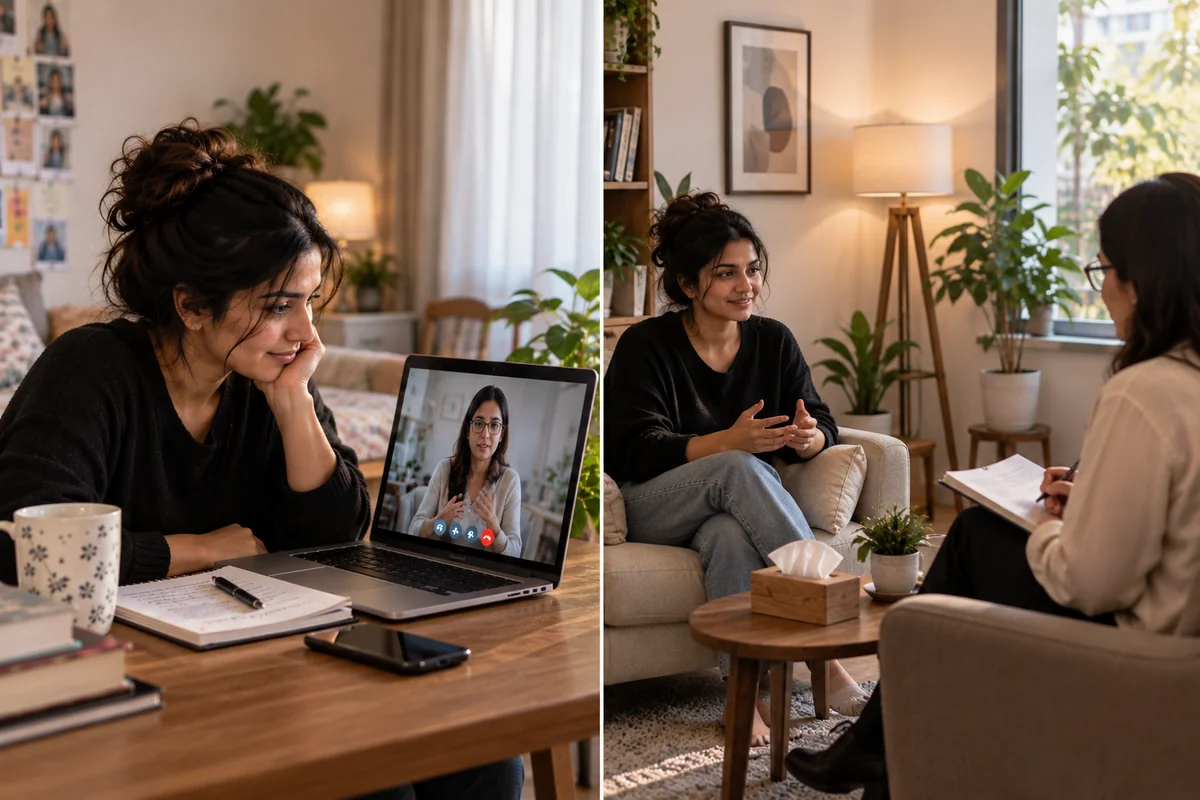
Crink sits in the middle of this range. In practice a Crink session works out to roughly ₹950 to ₹1,250 depending on how deep a plan you commit to, since longer programs carry a lower per-session rate, and you can begin with a single paid trial session that is adjusted into your plan price if you continue. That is a mid-market price for something the table above usually places a tier higher: a licensed psychologist plus genuine continuity between sessions. You are paying for two things at once: a qualified licensed psychologist who holds the clinical judgment and the relationship, and continuous support in the roughly 167 hours between sessions when most people are alone. Cri, the emotional AI companion, handles nudges, reflection, doubt-clearing, and handholding in those gaps, and escalates to a human clinician when something needs one. It is one continuous experience, human-anchored and AI-powered, not a handover between a bot and a person who has never met you.
The point is not that it is the most expensive or the cheapest. The point is that continuity is what compounds progress where most therapy stalls, so your care never starts over.
If you want to see what that difference feels like before committing to anything long-term, start with a single conversation.
How to judge value without overthinking it
You do not need to find the perfect price. You need to match the price to what you actually need right now.
If you are dipping a toe in and just want to journal or vent, a free or low-cost tool is a reasonable first step, and there is no shame in it.
If you are dealing with something that has been sitting on your chest for months, that follows you into meetings, that wakes you up at 3am, then a one-off cheap session is likely to disappoint you. Not because the therapist is bad, but because one disconnected conversation cannot do the work that continuity does.
Ask three plain questions before you pay, the same ones that help you choose any online counselling service:
Is there a licensed human clinician on the other side, and what is their qualification?
What happens between sessions, or am I on my own until the next slot?
Does my context carry forward, or do I re-explain myself every time?
The answers to those matter far more than whether you spent ₹700 or ₹2,200.
Spending less is not the same as spending well
The cheapest option wins only if the goal is to spend the least money today. If the goal is to actually feel different in a few months, the calculation changes. Therapy that starts over every session, or that leaves you unsupported in the long gaps, tends to be the most expensive kind of all, because you pay repeatedly for progress you never keep.
Pick the price that fits the size of what you are carrying, make sure a real clinician is involved, and look for care that continues rather than resets. That is how you turn money spent into change that lasts.
FAQ
Frequently Asked Questions
Is online therapy cheaper than in-person therapy in India?
Usually yes, at least a little. Online therapy removes travel and clinic overheads, so per-session rates often sit below comparable in-person sessions with the same calibre of clinician. The bigger savings, though, come from continuity and fewer dropped appointments rather than the sticker price alone. A cheap session you never follow up on costs more per unit of progress than a well-matched one.
Why do some online therapy services cost so much less?
The cheapest tiers are usually one of two things: an unlicensed peer-support or self-help app with no clinician behind it, or a single one-off session with no follow-up and no continuity. They are cheaper because they leave out the expensive parts, which are a qualified clinician and ongoing support. That is fine for light venting, but it is not the same product as continuous, human-led care.
Is cheaper therapy worth it?
It depends entirely on what you need. For a low-stakes first step or simple journalling, a free or low-cost tool is reasonable. For something that has been weighing on you for months, a disconnected one-off session often disappoints, because you start over each time and drop off in the gaps. In that case, cheap can end up costing more because you pay repeatedly for progress you never keep.
Does health insurance cover online therapy in India?
Coverage is inconsistent and worth checking directly with your insurer. Some Indian health policies now include outpatient mental health consultations, and Indian regulation has pushed insurers toward treating mental illness on par with physical illness, but many plans in practice still limit cover to hospitalisation or specific conditions. Ask whether outpatient psychology sessions, including online ones, are reimbursable under your specific policy before assuming they are covered.
What should I look for when comparing online therapy prices?
Look past the number and ask three things: is there a licensed clinician on the other side and what is their qualification, what support exists between sessions or are you on your own, and does your context carry forward instead of resetting each time. These factors shape your actual outcome far more than a few hundred rupees of difference in the session fee.