Work
Can't Stop Checking Work Email After Hours? What It's Doing to You
Checking work email after hours feels like diligence but it erodes sleep, recovery, and mental health. Learn what the research says and how to set real boundaries.
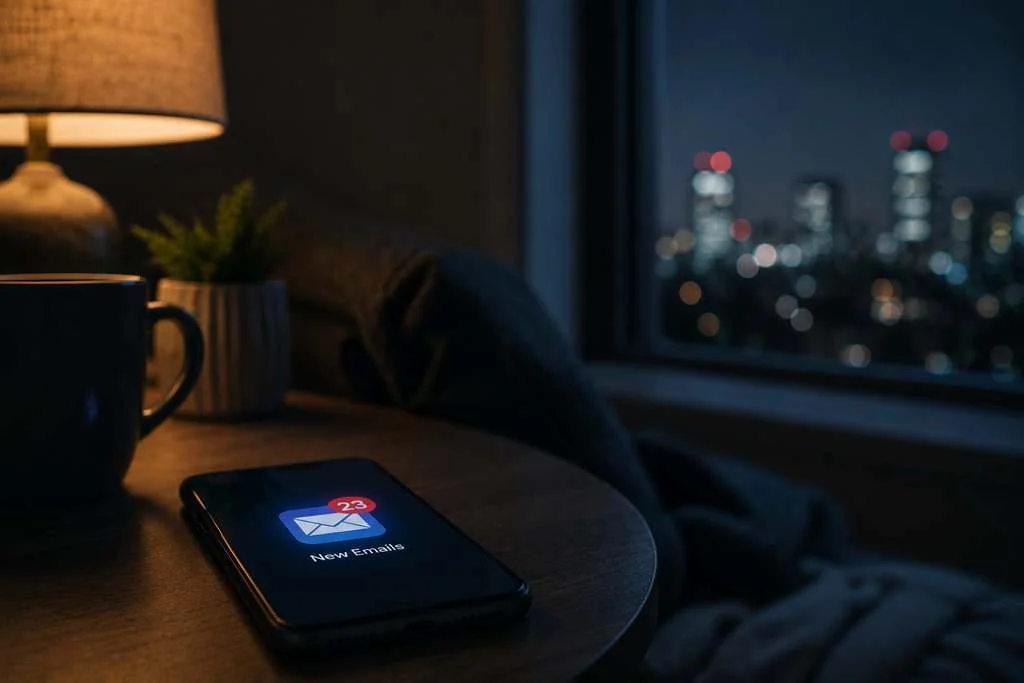
You tell yourself it is just a quick check. One glance at your inbox to make sure nothing is urgent. But that single glance is quietly dismantling your sleep, your recovery, and your mental health. The research is unambiguous: after-hours email checking harms psychological detachment and sleep quality, even when you do not respond to a single message.
The Paradox of the Diligent Checker
Here is the paradox. The person checking email at 9 PM is not lazy. They are not disengaged. They are usually the most committed person on the team. They check because they care. They check because they do not want to drop the ball. They check because being responsive feels like being good at their job.
But the very behavior that feels like diligence is the behavior that is quietly breaking down the systems that make them effective in the first place.
What You Think
You think checking email after hours means you are on top of things. You think it means nothing will surprise you in the morning. You think it means you are proactive, responsible, the kind of person people can count on. You might even feel a small hit of satisfaction when you see an email come in and you handle it before anyone else does. It feels like being ahead.
You might also think that checking is harmless because most of the time you do not even respond. You just look. You scan the subject lines. You confirm there is nothing pressing. Then you close the app. Five seconds. No damage done.
What’s Actually Happening
What is actually happening is that your brain never leaves work. The glance itself is the damage. When you open your work inbox after hours, you are pulling your nervous system back into a state of vigilance. You are telling your brain that the work day has not ended, that threats may still arrive, that you need to stay alert.
Research on incessant inbox monitoring shows that the constant checking pattern keeps workers in a state of anticipatory stress. Your brain does not distinguish between “I am just looking” and “I am working.” The same neural circuits activate. The same stress hormones flow. Your body prepares to respond even if your hands never touch the keyboard.
And here is the cruel part. The relief you feel when you see there is nothing urgent is not actual relief. It is the temporary reduction of an anxiety that was created by the checking itself. You are extinguishing a fire that you lit.
The Anatomy of the Email Check
Let us break down what actually happens in your brain and body when you check work email after hours. Understanding the mechanism matters because it strips away the story that checking is harmless.
What You Think
You think the process is simple. You open the app. You look. You close the app. A few seconds, maybe a minute. No big deal.
You think the content is what matters. If there is nothing urgent, you are fine. If there is something urgent, you deal with it. The checking itself is neutral. It is just information gathering.
What’s Actually Happening
The moment you open your work email, your brain performs a rapid threat assessment. This is not a conscious process. It is automatic, fast, and largely outside your awareness. Your prefrontal cortex engages. Your amygdala scans for problems. Your body releases cortisol and adrenaline in preparation for potential demands.
Even if you see nothing urgent, your nervous system has already shifted into activation. Heart rate may elevate. Muscle tension may increase, particularly in the shoulders and jaw. Your brain has been pulled out of whatever recovery state it was in and thrust back into work mode.
Then comes the rumination. You saw an email about a project. It is not urgent, but now you are thinking about it. You are mentally drafting a response. You are replaying a conversation with a colleague. You are worrying about a deadline that is still three days away.
This is what researchers call failure to psychologically detach. Studies on after-hours work email consistently find that the act of checking, independent of responding, reduces psychological detachment from work. And without detachment, your body cannot complete the recovery cycle it needs to function well the next day.
The email itself is not the problem. The checking is the problem. Every check is a micro-interruption of your nervous system’s recovery process, and those micro-interruptions accumulate.
What After-Hours Email Does to Your Sleep
Sleep is where the damage becomes most visible. And most people do not connect their poor sleep to their email habits because the checking feels so small, so incidental.
What You Think
You think checking email at 8 PM has nothing to do with the fact that you cannot fall asleep at 11 PM. You think your sleep problems are caused by other things: too much caffeine, a warm room, a restless partner, general stress.
You might even think that checking email helps you sleep because it reassures you that nothing is waiting for you. You feel like you can relax once you have confirmed the coast is clear.
What’s Actually Happening
When you check work email in the evening, you are introducing work-related cognitive arousal into the window when your brain should be winding down. The circadian system needs a gradual reduction in stimulation to transition into sleep. Work email is the opposite of gradual reduction. It is a sudden spike in cognitive demand.
Even if the emails are mundane, your brain processes them as tasks. Unresolved tasks create what psychologists call the Zeigarnik effect: the tendency to remember incomplete tasks more than completed ones. When you see an email that requires a response tomorrow, your brain tags it as unfinished. That unfinished tag keeps surfacing in your consciousness as you try to sleep.
The physiological impact is measurable. Research shows that after-hours work email is associated with reduced sleep quality, and the mechanism is clear: cortisol elevation in the evening interferes with the natural decline in body temperature and heart rate variability that precedes sleep onset.
If you are already showing early signs of burnout you should not ignore, disrupted sleep is one of the most reliable warning signals. And after-hours email checking is one of the most common disruptors.
The Workaholism Connection
This is where the conversation gets uncomfortable. Because for many people, after-hours email checking is not just a habit. It is a symptom of something deeper.
What You Think
You think you are dedicated. You think you are hardworking. You think the fact that you check email at night just means you take your job seriously, unlike people who clock out at 5 PM and disappear.
You might even feel proud of your availability. It feels like a competitive advantage. While others are relaxing, you are staying connected. You are in the loop. You are the person who knows what is happening.
What’s Actually Happening
What is actually happening may be closer to workaholism than you want to admit. Research on workaholism identifies compulsive working as a behavioral pattern driven by internal pressure rather than external demands. The key word is compulsive. You are not checking because your boss told you to. You are checking because not checking feels worse than checking.
This is the hallmark of addictive behavior. The behavior reduces anxiety in the short term but increases it in the long term. You check email to relieve the discomfort of not knowing. But the checking itself creates a new discomfort: the content of what you find, the rumination it triggers, the sleep it disrupts. So you check again the next night to relieve that discomfort. The cycle tightens.
A comprehensive overview of workaholism research notes that workaholics tend to have poorer health outcomes, lower relationship satisfaction, and paradoxically, lower job performance over time compared to engaged workers who maintain boundaries. The person who checks email at 9 PM is not outperforming the person who does not. They are burning out more slowly.
If this resonates with you, it is worth asking whether your workplace culture is contributing to this pattern. Some environments actively reward compulsive connectivity, which makes it harder to distinguish between personal drive and cultural pressure. You can read more about that in our guide on how to tell if your workplace is toxic.
Why Notifications Make It Worse
Most people do not intentionally sit down to check work email after hours. They get pulled in by a notification. A buzz, a banner, a sound. And then they are in.
What You Think
You think notifications are helpful. They keep you informed. You think you need them because you might miss something important. You think turning them off would be reckless, like deliberately ignoring your responsibilities.
You might also think that you can ignore a notification if it is not urgent. You see the banner, you assess, you decide it can wait. You feel in control.
What’s Actually Happening
Notifications are designed to override your intentions. That is their purpose. Every notification is an external trigger that pulls your attention away from whatever you are doing and directs it toward the app.
When a work email notification appears on your phone at 8 PM, several things happen in rapid succession. Your attention shifts. Your brain performs a threat assessment. You experience a micro-spike of stress. And you feel a near-compulsive urge to check, because the notification has created an open loop in your mind that wants to be closed.
Research on incessant inbox behavior shows that people who keep email notifications enabled check their email significantly more often than those who disable them, and they report higher levels of email-related stress. The notification does not just inform you. It commands you.
The problem is compounded by what happens after you look. If the email is not urgent, you feel a brief relief. But you have also reinforced the checking behavior. The relief acts as a reward, which strengthens the habit loop. Next time the notification appears, the urge to check will be stronger.
If you are working from home and finding that the boundary between work and personal life has collapsed entirely, this pattern is often at the center of it. Our article on work from home not working explores this in more depth.
The Identity Trap
Underneath the habit and the notifications, there is usually something more personal driving the behavior. Something about identity.
What You Think
You think being responsive is part of who you are. It is a value. It is a commitment. You think that if you stop checking email after hours, you will become a different kind of worker, a lesser one. You worry that people will think you do not care.
You might also derive a sense of importance from being needed after hours. If someone is emailing you at 9 PM, it means you matter. It means your role is significant. Stopping the checking feels like giving up that significance.
What’s Actually Happening
What is actually happening is that you have outsourced your sense of professional worth to your inbox. Your self-esteem has become contingent on being available, being responsive, being the person who is always there.
This is a fragile foundation for self-worth. It means your value as a professional is constantly being measured by the volume and urgency of emails you receive and the speed with which you respond to them. If the emails slow down, your sense of importance wobbles. If you stop responding quickly, you feel like you are failing.
The identity trap is what makes after-hours email checking so resistant to change. It is not just a habit. It is a way of proving to yourself that you matter. No amount of boundary-setting advice will work until you confront that underlying need.
When your inbox becomes the measure of your worth, every unchecked email feels like a small erasure of your value. That is not diligence. That is anxiety wearing a professional mask.
Take the Self-Efficacy Assessment
Breaking the Loop: A Step-by-Step Guide
Now that you understand what is actually happening, let us talk about how to change it. This is not about willpower. It is about redesigning your environment and confronting the beliefs that keep the habit alive.
Step 1: Disable Work Email Notifications on Your Phone
This is the single highest-impact change you can make. If your phone does not tell you there is a new email, you will not be pulled into checking by an external trigger. You will only check if you actively choose to, and active choice is much easier to resist than a reflexive response to a notification.
Go to your phone settings. Find your work email app. Turn off banners, sounds, vibrations, and badge counts. Do this now, before you finish reading this article. The resistance you feel right now is exactly why this step matters.
Step 2: Set a Hard Cutoff Time
Choose a specific time when your work day ends. Not “around 6 or 7.” A specific time. 6:00 PM. 6:30 PM. Whatever fits your schedule. After that time, you do not open your work email app. Not once. Not to check. Not to glance.
Communicate this cutoff to your team. Let them know that you will not be checking email after your cutoff time and that if something is genuinely urgent, they should call or message you through a designated channel. This communicates professionalism, not disengagement. It says: I take my work seriously enough to protect the energy I need to do it well.
Step 3: Create a Closing Ritual
The brain needs a signal that the work day is over. Without a ritual, the boundary between work and non-work blurs, and checking email feels like a natural continuation of the day rather than a violation of it.
Your closing ritual can be simple. Close your laptop. Write tomorrow’s top three priorities. Say out loud: “Work is done for today.” Walk to a different room. Change your clothes. Make tea. The specific actions matter less than the consistency. Do it every day.
Step 4: Replace the Checking Behavior
When you stop checking email, you will notice a void. The urge to check does not disappear immediately. It will surface in the gaps: while waiting for dinner to cook, during commercials, in the first minutes of lying in bed.
Have a replacement behavior ready. Something that occupies your hands and your attention. Read a book. Do a crossword puzzle. Text a friend about something non-work-related. Do ten stretches. The replacement does not need to be profound. It needs to be available and incompatible with checking email.
Step 5: Track What Happens to Your Sleep and Mood
For one week, do not check work email after your cutoff time. Each morning, rate your sleep quality on a scale of 1 to 10 and note your mood. Most people see improvements within three to four days.
This is not placebo. It is the natural result of allowing your nervous system to actually recover. When you see the data in your own life, it becomes much harder to convince yourself that the checking was harmless.
Step 6: Address the Underlying Identity Beliefs
This is the deepest step and often the most uncomfortable. Ask yourself: who would I be if I were not the person who is always available? What would it mean about me if I were someone who logged off and did not check?
The answers that surface will tell you a lot about what is actually driving the behavior. If your answer is “I would be lazy” or “I would be replaceable,” you have found the belief that needs attention. These beliefs are not facts. They are stories, and they are stories that are keeping you trapped in a cycle that is harming you.
This is where working with a therapist can be genuinely transformative. At Crink, our AI-native therapy platform is designed to help you unpack exactly these kinds of patterns: the behaviors that look like diligence on the surface but are driven by anxiety, insecurity, or unresolved pressure underneath. You do not have to figure this out alone, and you do not have to wait for a crisis to start.
When Your Job Actually Requires After-Hours Availability
Some roles genuinely require after-hours availability. If you are in a role like this, the goal is not to eliminate after-hours email entirely but to create structure around it.
What You Think
You think that because your role requires availability, the advice to stop checking does not apply to you. You think you are stuck. You think the only options are constant connectivity or career risk.
What’s Actually Happening
What is actually happening is that you have collapsed two different things into one: being available when needed and being available at all times. These are not the same thing.
If your role requires after-hours availability, define what that actually means. Is it a specific window? Is it for specific types of issues? Is it on specific days? Get clear on the actual requirement, not the imagined one.
Then create a structure that honors the requirement without making you perpetually tethered. This might mean checking email once at a designated evening time rather than continuously. It might mean routing urgent issues through a different channel so email can remain off. It might mean having a direct conversation with your manager about expectations.
The goal is intentional availability. You choose when to be reachable. You are not reachable by default.
The Recovery Payoff
Here is what changes when you stop checking work email after hours. Not in theory. In practice.
What You Think Will Happen
You think you will miss something important. You think anxiety will keep you up worse than the checking did. You think people will be frustrated with your unavailability. You think the discomfort of not checking will be unbearable.
What Actually Happens
In the first two or three days, you are right about the discomfort. The urge to check will be strong. You will feel a pull toward your phone. You might even feel a vague sense of unease, like you have forgotten to do something.
By day four or five, something shifts. The anxiety begins to fade. Your brain starts to trust that checking is not coming, and the anticipatory stress that drove the urge begins to release.
By week two, the changes become measurable. Sleep improves. You fall asleep faster. You wake up less during the night. Your mood in the morning is different, less compressed, less immediately tense.
You also discover something surprising. The things you thought you would miss were not actually urgent. The emails that came in after your cutoff time waited until morning, and the world did not end. Your colleagues did not revolt. Your boss did not question your commitment. In most cases, nobody even noticed.
Most people discover that the urgency was never in the emails. It was in them. The emails were just the stage on which they performed their anxiety about being enough, doing enough, mattering enough.
If you are already deep in burnout, stopping after-hours email is necessary but not sufficient. Recovery requires a more comprehensive approach. Our guide on burnout recovery: what actually works walks through the full picture.
The Bigger Picture
After-hours email checking is not a personal failing. It is a behavior that emerges at the intersection of workplace culture, technology design, and personal psychology. The notifications are engineered to capture you. The workplace culture often rewards perpetual availability. And your own mind may be using the checking to manage deeper anxieties about worth, competence, and security.
But here is the thing. You do not have to wait for your workplace to change. You do not have to wait for the technology to become less addictive. You can change your own behavior, and that change can have an outsized impact on your wellbeing.
The research is consistent. Psychological detachment from work is not a luxury. It is a biological necessity. Your brain and body require periods of disconnection to repair, consolidate, and prepare for the next day. When you check email after hours, you are stealing that recovery time from yourself, one glance at a time.
You deserve to rest. Not because you have earned it through sufficient suffering. Not because you have checked enough emails to prove your commitment. You deserve to rest because you are a human being with a nervous system that has limits.
The email can wait. It has always been able to wait. The question is whether you are willing to let it.
The most professional thing you can do is not to be available at all times. It is to be rested enough, recovered enough, and well enough to do your best work during the hours you are actually supposed to be working.
FAQ
Frequently Asked Questions
Is checking work email after hours really that harmful?
Yes. Research shows that after-hours work email is associated with reduced psychological detachment from work, poorer sleep quality, and elevated stress hormones. Even brief checking keeps your brain tethered to work mode, preventing the recovery your nervous system needs.
What if my job requires me to be available after hours?
Some roles genuinely require after-hours availability. In those cases, define specific windows rather than constant availability, communicate expectations clearly with your team, and protect recovery time during your off periods. The goal is intentional availability, not perpetual connectivity.
How is checking email different from just thinking about work?
Thinking about work is internal rumination, which is already harmful. Checking email adds an active behavioral loop that brings new work stimuli into your evening, triggering fresh stress responses and extending the work day psychologically even if you do not respond.
Will my employer think I am not committed if I stop checking email?
Concern about appearing uncommitted is one of the main drivers of after-hours email checking. However, research on workaholism shows that constant connectivity correlates with worse performance over time, not better. Setting boundaries often signals professionalism, not disengagement.
What is the first step to breaking the after-hours email habit?
Start by turning off work email notifications on your phone after your work day ends. Then designate a specific cutoff time and stick to it for one week. Notice what happens to your sleep and mood. Most people find the anxiety of not checking fades within a few days.
Updated on July 8, 2026