Self
Best Online Therapy Apps in India: What to Compare
A practical, psychologist-reviewed guide to comparing online therapy apps in India: what actually matters (therapist credentials, fit, privacy, format) before you pay.

Question: What should I compare when choosing an online therapy app in India?
Compare five things, not the marketing: the therapist’s credentials and supervision, whether you are matched to a real licensed professional (not only a chatbot), session format and continuity with the same therapist, data privacy, and total cost including renewals. Price and app polish matter far less than therapist fit and continuity.
You are busy. You are probably reading this between meetings or after the kids are asleep, and you want one clear answer: which app is worth your time.
That makes the usual app-store signals misleading. A clean interface, a first-session discount, or a celebrity-backed brand can look reassuring while telling you almost nothing about whether you will still be with the same qualified person a month from now.
The “best” app is the one that connects you to the right human, consistently, in a format you will actually keep using.
Why this choice is harder than it looks in India
India carries one of the largest unmet mental health needs in the world. According to a landmark study in The Lancet, contact coverage for common mental and substance use disorders in India is very low, and less than 1% of the national health budget goes to mental health. More recent work on digital psychiatry in India describes demand rising faster than supply, which is exactly why so many apps have appeared, and why quality varies so widely.
So the apps are filling a real gap. The catch is that “online therapy app” can mean anything from a licensed psychologist on a video call to an unsupervised chatbot. Comparing them on download count or interface misses the point.
Research on the market available to Indian users shows why caution is sensible. In a 2025 systematic review of 350 mental health apps accessible in India, 65.1% did not report involvement of mental health professionals and only 10.9% referenced empirical research. In other words, there are many ways to look professional without being clinically serious.
What actually matters: a comparison checklist
| What to compare | Why it matters | Green flag |
|---|---|---|
| Therapist credentials | Outcomes depend on the professional, not the app | Named, licensed psychologists with stated qualifications |
| Matching and continuity | Therapy works through a stable relationship | You see the same therapist each session |
| Human vs AI-only | AI can support but should not replace care | Clear about where AI helps and where a human takes over |
| Privacy and data | Mental health data is sensitive | Transparent data policy, India-appropriate consent |
| Format fit | The plan you will actually keep | Video, chat, or async options that suit your schedule |
| Total cost | Renewals add up | Clear pricing, no surprise renewal traps |
Each row in that table is really a question you should be able to answer in under five minutes before you pay.
- Who exactly will I be speaking to? You should be able to see the person’s name, qualification, and role.
- Can I stay with the same therapist if it is going well? Restarting repeatedly drains the value out of the process.
- What happens if the issue is bigger than self-help? A trustworthy platform is clear about when a human professional steps in.
- What data is collected and where does it go? A JAMA Network Open assessment of mental health and smoking cessation apps found third-party data sharing was common and often poorly disclosed.
- What will this actually cost after the introductory offer? The cheapest first session is not the cheapest plan if continuity breaks the moment you try to continue.
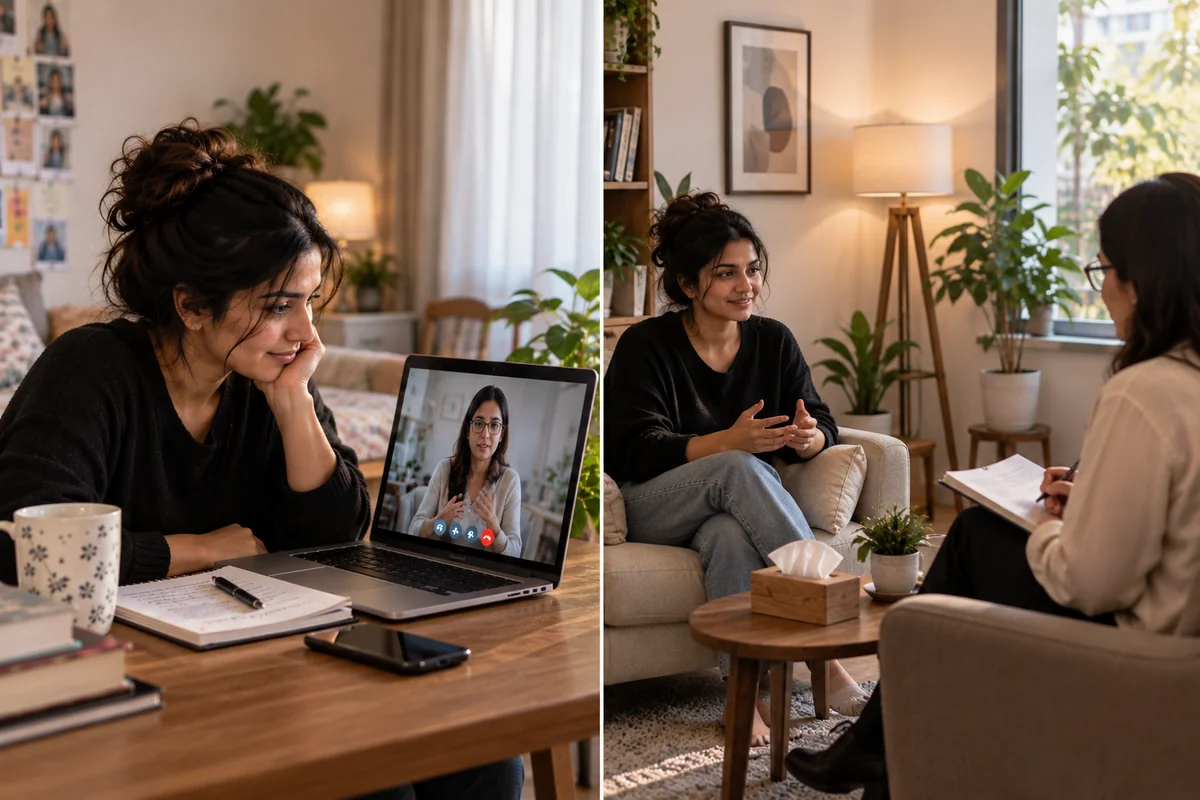
The continuity point matters more than most people expect. According to a review of videoconferencing psychotherapy, therapeutic alliance can be built effectively online, with clients often rating bond and presence at least as strongly as in-person settings. That means the screen is not usually the weak point. The real risk is fragmentation.
Not sure how much stress you are carrying? Take the free 2-minute Stress Assessment.
Take the free Stress Assessment ->Does online therapy actually work as well as in person?
For most people with common concerns, yes. According to a meta-analysis in Depression and Anxiety, synchronous telehealth psychotherapy for depression showed no statistically significant difference compared with in-person delivery. A 2025 systematic review in the Journal of Telemedicine and Telecare reached a similar conclusion overall, with only small differences favouring in-person for some conditions. The medium is rarely the problem; therapist fit is what moves the needle.
What weakens online therapy is not distance so much as instability. If the format makes you spend the first 20 minutes of each new session rebuilding trust and history, the convenience disappears. A lower sticker price is not really cheaper if it keeps you emotionally starting over.
Continuity with one professional is the active ingredient, online or not. What weakens therapy is starting over with a new stranger every few weeks.
If you want a fuller picture of how online support works, our explainer on therapy for anxiety and depression is a good next read.
A note for readers across India (and Kerala specifically)
Language and cultural fit matter more than most apps admit. If you are in Kerala, look for services with Malayalam-speaking, culturally fluent professionals; being understood in your own idiom shortens the distance to feeling helped. The same holds across India’s other regions and languages, the right app should meet you in a context you actually live in, not a generic script. Crink matches you to a consultant who understands your context.
Research on culturally responsive CBT suggests therapy can work across diverse groups, but it also highlights that culture shapes engagement. Language, family norms, faith, class, and workplace expectations are not side details. They are part of the problem you are bringing in.
If you are explaining burnout from a Gulf-return household, guilt about aging parents, pressure around marriage, or the loneliness of being the “strong one” in your family, you should not have to spend half the session translating your world before the work can begin.
What Crink offers
Crink connects you to licensed consultant psychologists for one-on-one consultations, with continuity (the same consultant across your journey) and an AI layer (Cri) that supports between sessions rather than replacing the human. You can start by talking to Cri or booking a consultation.
That model is designed for real schedules, so you can move into structured human support without having to restart your story from zero.
FAQ
Frequently asked questions
Is online therapy effective for anxiety and depression?
Yes, for most common concerns the research shows online delivery performs comparably to in-person therapy. The key factor is the quality and continuity of the therapist, not the format.
Is an app with a chatbot enough on its own?
A chatbot can help you reflect, track mood, or get through a hard moment, but it is not a substitute for a licensed professional when distress affects your daily functioning. Look for apps that are honest about this line.
How do I know the therapist is qualified?
The app should name the professional and their qualification. If you cannot see who you are talking to, treat that as a red flag.
What about privacy?
Your mental health data is sensitive. Choose services with a transparent data policy and clear consent, appropriate for Indian users.
How much should I budget?
Look at total cost including renewals, not just the first session. Continuity matters, so a sustainable plan you can keep beats a cheaper one you abandon.
Updated on June 20, 2026